How Does Compound Interest Work? (Formula + Examples)
 Dennis Vymer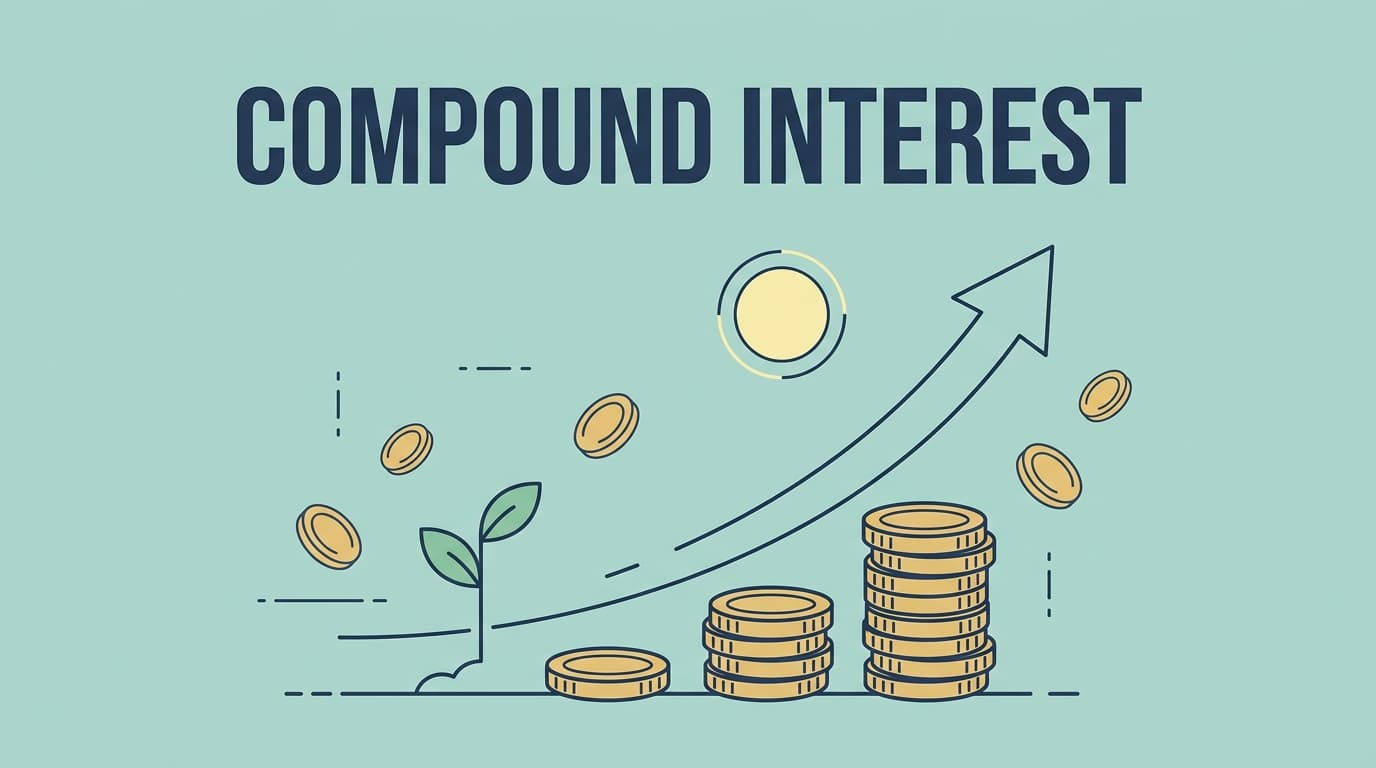
Compound interest works because your growth starts earning growth. Year one you earn a return on what you put in. Year two you earn a return on the original money plus year one's gain. Repeat for thirty years and $10,000 at 7% a year becomes $76,123, without adding a cent.
Simple interest would have given you $700 every year — $21,000 of growth over thirty years. Compounding gave you $66,123. The difference is not the rate. It is that the base keeps getting bigger.
That is the entire idea, and everything below is just watching it happen.
What is actually happening each year?
Picture a snowball rolling downhill. Every rotation picks up snow, which makes the ball bigger, which means the next rotation picks up more snow. Nothing about the hill changed. The ball did.
Money behaves the same way when returns are left alone to reinvest. In year one your $10,000 earns $700. In year two the 7% applies to $10,700, so you earn $749. That extra $49 is compound interest — a return on a return — and it looks trivially small.
Give it thirty years and that trivial mechanism produces the last row of the table below.
How does compound interest work? Growth is added back to the balance, so the next round of growth is calculated on a larger base. Earn 7% on $10,000 and you have $10,700. Earn 7% again and it applies to the whole $10,700, not just the original $10,000, so you earn $749 rather than $700. Each year the base is bigger than the last, which means each year's gain is bigger than the last, and the curve bends upward instead of running straight. The formula is A = P(1+r/n)^(nt), where P is what you start with, r is the annual rate, n is how many times a year interest is added, and t is the number of years. The variable almost nobody respects enough is t, because it sits in the exponent while the rate is only multiplied. Time does more work here than rate, and it is the one input you cannot buy back later.
The compound interest formula, in words
A = P(1 + r/n)^(nt)
Four inputs, one output.
- P is the principal — what you start with.
- r is the annual interest rate as a decimal, so 7% is 0.07.
- n is how many times a year interest is added to the balance.
- t is the number of years.
- A is what you end up with.
The part worth understanding is n. Take the same $10,000 at 7% for 30 years. Add the interest once a year and you get $76,123. Add it monthly instead, so n = 12, and you get $81,165 — $5,042 more from nothing but the timing of when growth joins the balance.
And notice where t sits: in the exponent. r is multiplied; t is a power. That asymmetry is why a mediocre return over a long period beats a great return over a short one, and it is the mathematical reason starting early matters more than picking well.
Watching it accelerate
$10,000, 7% a year, nothing added, nothing withdrawn.
| End of year | Balance | Growth that year |
|---|---|---|
| 0 | $10,000 | — |
| 1 | $10,700 | +$700 |
| 2 | $11,449 | +$749 |
| 3 | $12,250 | +$801 |
| 5 | $14,026 | +$918 |
| 10 | $19,672 | +$1,287 |
| 15 | $27,590 | +$1,805 |
| 20 | $38,697 | +$2,532 |
| 25 | $54,274 | +$3,551 |
| 30 | $76,123 | +$4,980 |
Look at the right-hand column rather than the balance. Year one produced $700. Year thirty produced $4,980 — from the same money, at the same rate, doing nothing different.
Now group it by decade:
- Years 1–10: +$9,672
- Years 11–20: +$19,025
- Years 21–30: +$37,426
The third decade delivered nearly four times what the first did. This is why compounding feels like it does not work for years and then suddenly does. It was always working; the numbers were just small.
What happens if I add money every month?
The lump-sum example is the clean way to see the mechanism. Monthly contributions are how it actually gets used.
Put $500 a month into the same 7% return, compounded monthly, for 30 years. You contribute $180,000 of your own money. You end with $609,986.
Growth accounts for $429,986 of that — more than twice what you put in. And the ordering matters enormously: the dollar you invest in year one gets thirty years of compounding, the dollar you invest in year twenty-nine gets one. Same dollar, wildly different jobs.
Where does the 7% come from?
Not from optimism. Since 1928, the S&P 500 with dividends reinvested has returned 10.22% a year in nominal terms and 6.94% a year after inflation, measured through July 2026 (full return series). The Trinity University researchers behind the well-known withdrawal-rate study calculated the same thing over 1926–1995 and got "roughly 10.5%" a year for large-company stocks (AAII Journal, February 1998).
So 10% is the headline number and roughly 7% is what is left after inflation eats its share. Every figure in this article uses 7%, which means every result is already in today's purchasing power — no mental adjustment needed. If you want the mechanics of why the headline number and the real number differ, I wrote about inflation separately.
Two caveats I would want stated. These are long-run averages over periods containing two world wars, the Great Depression and 2008 — no individual decade looks like the average. And they describe a broad index, not a stock you picked. If any of this is new, start with investing made simple.
The rule of 72
Divide 72 by your annual return and you get the approximate number of years for money to double.
At 7%: 72 ÷ 7 = 10.3 years. The exact answer is 10.24 years, so the shortcut is off by less than a month.
At 10%: 72 ÷ 10 = 7.2 years, against a true 7.27. Also close.
It drifts at extremes — at 24% the rule says 3 years and the truth is 3.22 — but for the 4–12% band where most investing decisions live, it is accurate enough to do in your head while someone is still opening a spreadsheet.
Compounding runs in reverse, too
Everything above describes a mechanism, not a blessing. Turn it around and it becomes the most expensive force in household finance.
The Federal Reserve's G.19 consumer credit release put the average interest rate on US credit card accounts assessed interest at 22.15% in June 2026. Because card interest is charged monthly, that 22.15% headline is really an effective 24.54% a year once it compounds on itself.
Leave a $6,000 balance untouched for a year and it becomes $7,473. Leave it two years and it is $9,307 — you have paid more than half the original balance in interest without buying anything.
The same $6,000 attacked with $200 a month clears in 45 months and costs $2,823 in interest. Same debt, same rate, different behavior. That gap is why high-rate debt generally beats investing as a use of a spare dollar: paying off a 22% balance is a guaranteed 22% return, and no market offers that.
Fees compound too, which is the part nobody feels
Two funds, both returning 7% before costs. One charges 0.20% a year, the other 1.50%. That is a 1.3-point difference, which sounds like rounding.
Over 30 years, on $100,000:
| Annual fee | Net return | Value after 30 years |
|---|---|---|
| 0.20% | 6.80% | $719,677 |
| 1.50% | 5.50% | $498,395 |
The expensive fund cost you $221,282 — 31% of the final pot — for a fee that never appeared on a statement as a charge you noticed. Fees do not subtract from your return. They subtract from your compounding, every year, on a base that would otherwise have been growing.
Run it on your own numbers
Reading a table about $10,000 is fine. Seeing your own balance in it is different.
Our compound interest calculator takes a starting amount, a monthly contribution and a rate, and shows the curve year by year. Free, no signup. And if you have ever wondered what an actual past investment would have done, what if I invested runs it against real historical market data instead of a flat assumed rate.
One last thing about that $76,123. Nothing clever produced it. No timing, no stock picking, no strategy — just $10,000 that was left alone for three decades. The hardest part of compound interest has never been understanding it. It is not interrupting it.
Frequently asked questions
- What is the compound interest formula?
- A = P(1 + r/n)^(nt). P is the principal you start with, r is the annual rate as a decimal, n is how many times a year interest is added to the balance, and t is the number of years. A is the final amount. Note that t sits in the exponent, which is why time matters more than rate.
- What is the difference between simple and compound interest?
- Simple interest is always calculated on the original amount; compound interest is calculated on the running balance. $10,000 at 7% for 30 years earns $21,000 with simple interest and $66,123 with compounding. The rate is identical — the difference is entirely that the base keeps growing.
- How much does $10,000 grow in 30 years at 7%?
- It becomes $76,123 with annual compounding and nothing added. The acceleration is the interesting part: the first decade adds $9,672, the second adds $19,025, and the third adds $37,426. Same money, same rate, nearly four times the annual growth by the end.
- What is the rule of 72?
- Divide 72 by your annual return to estimate how many years your money takes to double. At 7% that gives 10.3 years against a true answer of 10.24 — accurate to within a month. It drifts at very high rates, but it holds well across the 4-12% range where most investing decisions sit.
- Does compound interest work against you on debt?
- Yes, and faster. The Federal Reserve put the average rate on US credit card accounts assessed interest at 22.15% in June 2026, which compounds monthly to an effective 24.54% a year. A $6,000 balance left untouched reaches $7,473 after one year and $9,307 after two.
- How much do fund fees cost over 30 years?
- More than the headline suggests, because fees reduce the base that compounds. On $100,000 over 30 years at 7% before costs, a 0.20% annual fee leaves $719,677 while a 1.50% fee leaves $498,395. That 1.3-point difference costs $221,282 — about 31% of the final pot.
Stay updated
Get notified when we publish new articles.
Ready to apply this?
Start tracking your finances today and put these tips into practice.
- Import bank statements in seconds
- AI-powered categorization
- Beautiful visualizations
- Set and track financial goals
Related posts

Increase Monthly Investment Every Year. I Didn't, and That Was a Pay Cut I Gave Myself.
A month ago I called my unchanged monthly ETF transfer a sign of discipline. It is a pay cut. A contribution frozen since 2020 buys about 22% less, and a 10% savings rate drifts to under 8% with nobody deciding anything. Automate the buy. Never automate the amount.

Investing App Gamification: Check What Your Broker Earns
The confetti isn't the problem, the revenue model is. A ten-minute test of what your broker earns while you do nothing, and why Europe and the US differ.

When to Sell Index Funds: Four Tests Before You Touch Them
Not on a price or a date. Sell index funds only when one of four written-down tests is met, and keep a never-list for when panic poses as a plan.