My Wife's Fun Money Is Bigger Than Mine. I Set It Up That Way.
 Dennis Vymer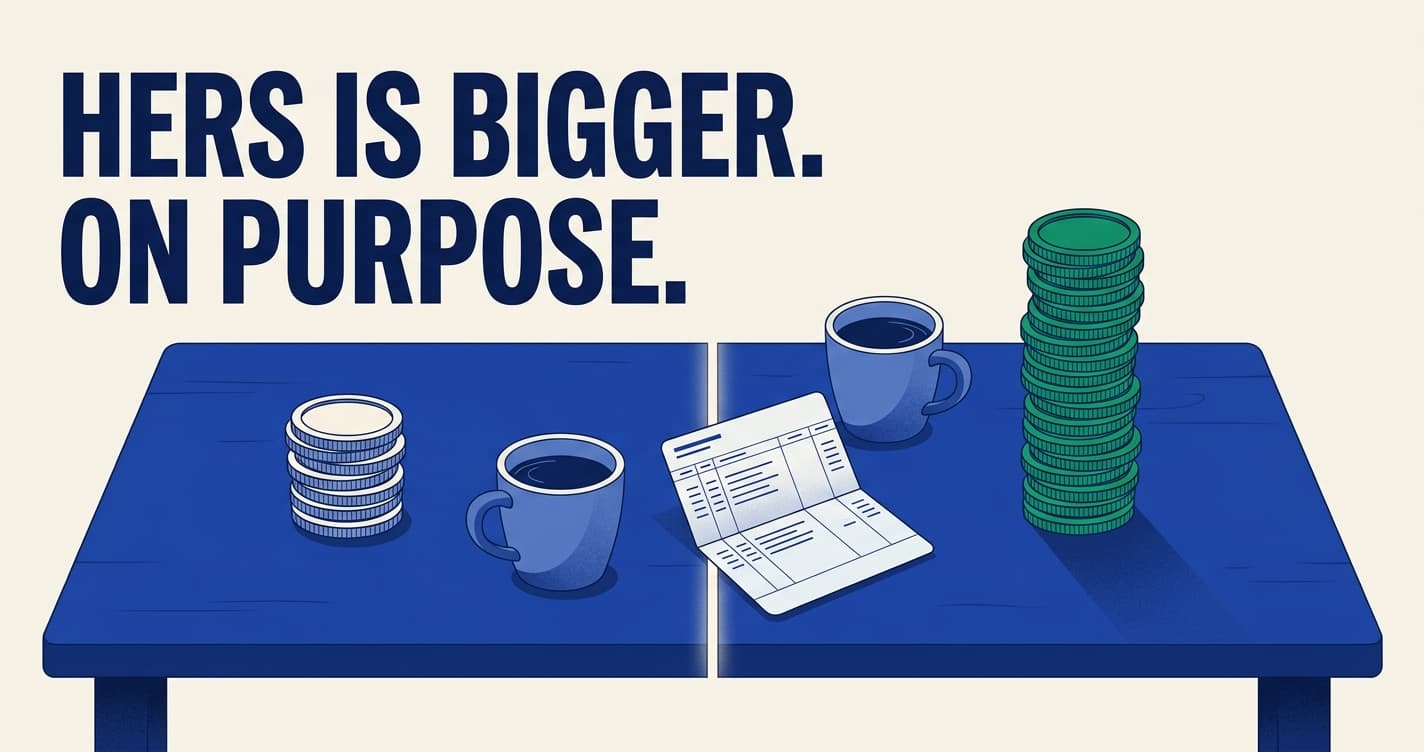
For about half a year we ran equal fun money, because that's what everyone says you do. Same number for her, same number for me, drawn from the same household pot. It looked fair on the screen. It was quietly making one of us miserable.
She'd hit the bottom of hers somewhere around the third week and go quiet about it. Not a fight — my wife doesn't do fights about money — just a slightly flat mood on a Saturday when the obvious thing to do would have cost twenty minutes of thinking about whether it was allowed. Meanwhile I'd get to the end of the month with a pile sitting there doing nothing, because my ideal afternoon is a coffee and a sandwich on my own front porch and that is not an expensive hobby.
So we changed it. Same total fun-money budget for the household, split differently: roughly two thirds to her, one third to me. That's it. That was the whole intervention, and I've never once felt like I gave something up.
Equal fun money is fairness theatre
The advice everyone gives is symmetric, and it comes in two flavours. Flavour one, the Ramsey-style version: pool everything, then give each person an identical personal line. Flavour two, the couples-app version: split the household costs in proportion to who earns what, then each keeps their own remainder. Both are obsessed with looking balanced.
Neither one asks the only question that matters, which is what each of you would actually miss.
Equal fun money optimises for a screenshot. If the two numbers match, nobody can accuse anybody of anything. But a matched pair of numbers isn't fairness when one of you genuinely enjoys spending and the other genuinely doesn't. All it does is guarantee that one person is constrained and the other person is sitting on unspent money, which is a strange outcome to be proud of. We ran that system. I know exactly what it produces.
Here's the thing I'd push back on hardest: the bigger pile isn't compensation for anything, and the smaller one isn't martyrdom. I didn't hand her the difference as a favour. My share of that money already went somewhere with a longer payout — the savings rate that gets us a date around 40 and a lot of free Wednesdays before then. I picked time. She picked a nicer version of now. Both piles come out of the same pot and both of us know the other number.
Pool everything. Then carve out the piles anyway.
I want to be precise about what we do, because "we have separate fun money" gets misheard as "we have separate finances." We don't. One household income, one set of household expenses, no 60/40 split of the electricity bill, no "your half" of anything. I wrote up the whole system in how we run money in a marriage if you want the boring mechanics.
And the research is firmly on the side of pooling. Gladstone, Garbinsky and Mogilner ran six studies with over 38,000 people and found couples who pool all of their money report higher relationship satisfaction and are less likely to break up — with the effect strongest among couples who don't have much money to pool. That last part is the bit people skip.
So why carve out personal piles at all, if full pooling wins?
Because of a much smaller, much more specific finding that I think is the most useful thing in this entire field. Garbinsky and Gal showed that when people spend from a joint account, they shift toward utilitarian purchases and away from hedonic ones — not because they're broke, but because joint money carries a justification tax. Buying something useful from the shared account needs no defence. Buying something purely enjoyable does. So people quietly stop buying the enjoyable thing.
That's the whole argument for fun money in one sentence. The pile doesn't exist to separate your finances. It exists to delete the justification tax on the small percentage of spending where enjoyment is the point.
And it turns out this is the split almost nobody makes. Everyone's busy dividing the bills.
The dividing is happening. It's just the wrong dividing.
 Data: U.S. Census Bureau, Survey of Income and Program Participation (2025 release).
Fully pooled households used to be the majority and now aren't. The share of married couples holding all their accounts jointly fell from 53% in 1996 to 40% in 2023, and the share with no joint account at all went from 15% to 23%. It's an American dataset, and I'd bet money the European curve points the same way — later marriages, two established careers, two apps already set up.
I'm not going to pretend that's a catastrophe. Marrying at 30 instead of 24 with a decade of your own financial history behind you is a perfectly good reason to hesitate before merging everything.
But look at what's being separated. It's the infrastructure: the accounts, the bills, the who-pays-for-what. The thing people are least willing to separate is the treats, because separating the treats feels selfish. That's exactly backwards. Separate the joy, share the machine.
An allowance and a named line are not the same thing
The internet had a good scrap about this in the summer, over the so-called "splowance": one spouse handing the other a monthly allowance, in the viral version with bonus tiers attached to things like love notes. George Kamel's response was that the entire framing should be offensive to all people groups, and he's right. If one adult in a household has to request access to money, resentment is the only possible output.
We agree on that completely and then part ways on the next sentence, because his fix is equal personal lines. Mine isn't.
The difference between an allowance and what we do isn't the size of the number. It's who set it. An allowance is one person deciding for the other. Ours got decided in about four minutes at a kitchen table by two people looking at the same statement, and either of us can reopen it next month. She has access to my fun-money account. I have access to hers. Neither of us has ever needed to look, which is sort of the point.
The other reason I'd defend the named line: the alternative to naming it isn't harmony, it's secrecy. Surveys keep finding roughly a quarter to a third of people in relationships hiding some spending, debt or income from their partner, and the research on financial infidelity finds the main motivation is anticipating a fight about it. A pile that's been said out loud removes the reason to hide. There's nothing to confess if the answer was decided in advance.
What it actually looks like, including the untidy parts
I don't run envelopes. I've tried, and I find the whole cash-stuffing school of budgeting too rigid for a household with a small child in it. Life happens. Somebody's pile runs dry in a month that had a wedding in it, and we move money, and nothing bad occurs.
Two buckets are actually sacred:
- Investments go out first, on payday, before anything else gets a vote.
- We didn't spend more than we made this month.
Everything downstream of those two is a conversation, not a rule. How the second bucket gets divided can change month to month. The long-term direction doesn't move at all.
What the piles get spent on is mostly small and mostly forgettable. A restaurant lunch. A dinner out. Something that arrives in a box. The bit I'd actually recommend to anyone is the ritual attached to it: one of us takes the other out, paid from their own pile. Not from the household. From theirs. It reframes the money as something you can spend on the other person rather than something you have to defend to them, and it costs nothing to set up.
The naming happens at the money date. Five, maybe ten minutes with a coffee, the bank statement pulled into the tracker I build, what went in, what went out, and are the piles still the right size. That's a boring conversation because we have it constantly. Couples who only have it once a year have a much more interesting one.
The reason this matters more at a high savings rate
We save a large share of our household income — it was around 60% before our daughter arrived and it's around 50% now, and that shift cost us about six months, not six years.
You cannot hold a rate like that for years on discipline. Discipline runs out. It runs out fastest in the person who didn't pick the goal in the first place — and in most households one person drives the financial independence project and the other agrees to it, which is a real asymmetry that most FIRE writing pretends doesn't exist. I'm the driver here. My wife is genuinely on board with where we're going. Those are not the same thing, and if I ever confuse them we're in trouble.
So the fun money isn't a leak in the savings rate. It's what makes the savings rate survivable. It's a small, deliberate, ring-fenced amount of not optimising, sized to what each person would actually miss. Take it away and the rate holds for maybe eighteen months before somebody quietly decides this whole thing is a bit joyless and stops caring about it. I'd rather pay the couple of percent.
Which is the honest reason we've gone years without a fight about money, and it isn't the split. Any split would have worked. What worked is that the split gets said out loud, every month, by both of us — so neither one is sitting there keeping score in their head.
The piles are unequal, and they're unequal in her favour, and I chose it. I'd choose it again next month. Ask me in five years and the ratio will probably have moved again, because the person it's sized for will have changed, and that's the entire system working exactly as intended.
Stay updated
Get notified when we publish new articles.
Ready to apply this?
Start tracking your finances today and put these tips into practice.
- Import bank statements in seconds
- AI-powered categorization
- Beautiful visualizations
- Set and track financial goals
Related posts

The Money Talk Before Marriage: We Did It in One Evening
Before our wedding we each put every number on one sheet: assets, debts, income, habits. Why that beat a list of questions, and why we then merged it all.

Accumulating vs Distributing ETF: Why Mine Pays Nothing
I buy one accumulating world ETF every month and it has never paid me a cent. Why I skip distributing funds while building, and why I'll sell shares later.

Coast FIRE Isn't a Permission Slip. For Us It's a Deadline — and We Won't Downshift When We Hit It.
Our coast FIRE number lands around 40 and I haven't crossed it yet. The internet treats that day as permission to quit and go part-time. I pulled 150 years of returns and ran the numbers: buying a four-day week costs one year of full FI, stopping costs sixteen.