How to Stop Fighting About Money in a Relationship
 Dennis Vymer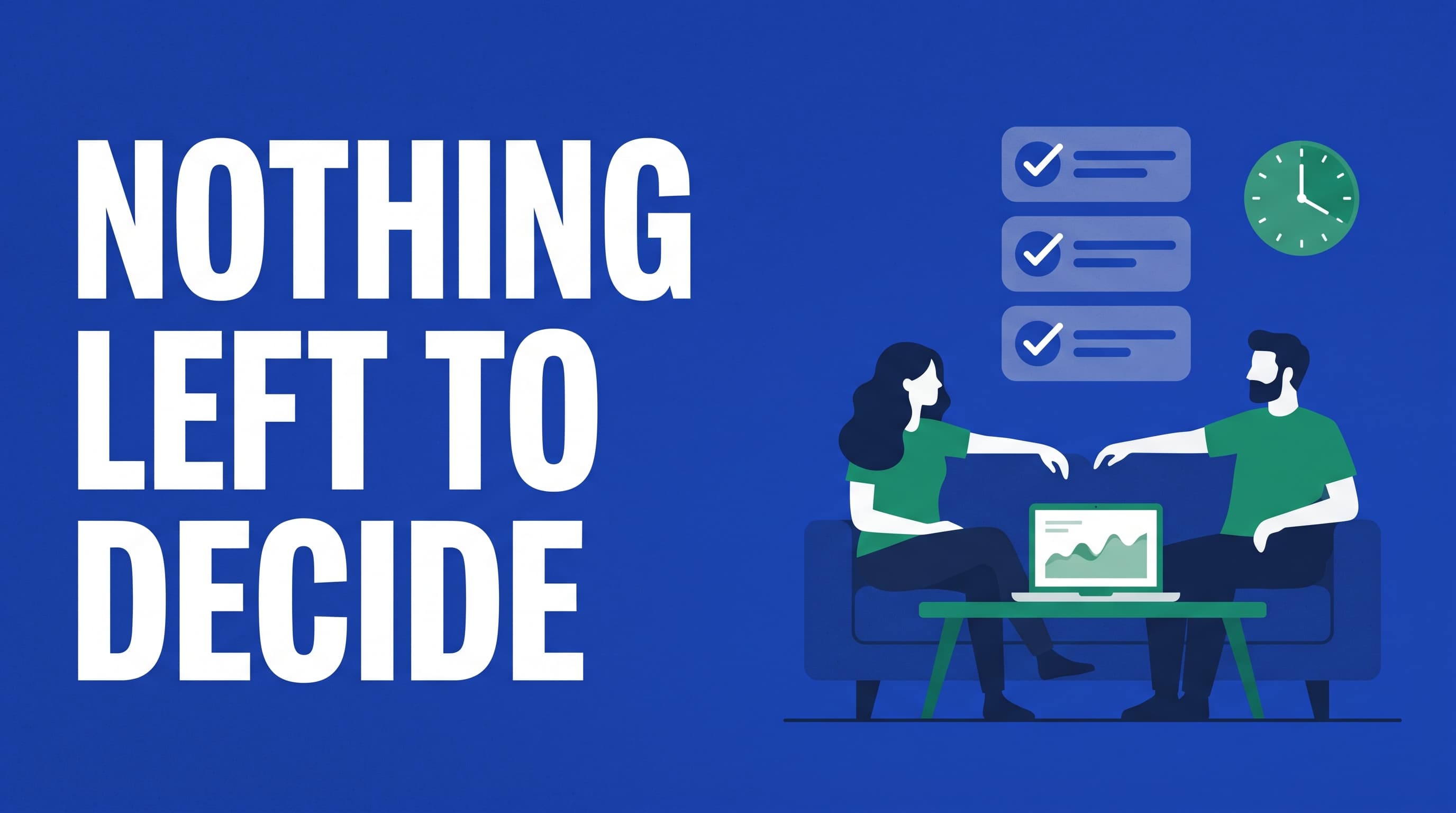
Sunday evening, last one of the month, laptop plugged into the TV. Coffee going cold on the armrest. My wife at one end of the couch, me at the other, the numbers up on the screen. Twenty minutes and we were done, same as almost every month for years.
For a long time I told myself that was because we're good at talking about money. Two reasonable adults, no drama, look at us go.
It isn't that. Nearly every article I've read on how to stop arguing about money with your partner says the same thing: talk more, talk earlier, talk more often. We talk about money less than we did five years ago. We also stopped arguing about it around then. Those two facts are connected, and not in the direction the advice assumes.
The meeting is short because there's almost nothing in it that's still up for debate. That's the whole trick, and it took me an embarrassingly long time to notice it wasn't a personality trait.
Half of couples skip the conversation on purpose, and in the short run it works
Fidelity ran a big couples study this year with Versta Research, 3,193 married or partnered US adults who'd been together at least three years, fieldwork in late 2025. The headline number everybody quoted: 49% avoid money conversations to prevent arguments. Not "forgot to have them." Avoid them, on purpose, as a strategy, to keep the peace.
The rest of that study reads like self-deception. 85% of the same people describe themselves as good financial partners. 69% aren't regularly talking about long-term finances at all, and 41% wish they were.
 Data: Fidelity Investments, 2026 Couples & Money Study (Versta Research, n=3,193).
A separate TD Bank survey of 2,000 US adults this summer found nearly three in five have felt at least occasionally scared or embarrassed to talk openly about their finances with a partner. That sample leans on six metro areas, so I wouldn't stretch it to "Americans," but the direction isn't subtle.
Here's where I part company with basically the entire genre. Every one of those articles treats the avoiders as cowards who need to be talked into bravery. They aren't. Avoidance is a rational strategy that delivers exactly what it promises: fewer fights this month. It just doesn't do anything about next month, because the thing generating the fight is still sitting there, untouched.
Telling half your readers to walk back into the fire, with no new equipment, is not advice. It's a dare.
What couples argue about isn't money. It's undecided money.
The best evidence I found on this isn't a survey at all, and nobody in the search results seems to have read it.
In 2009, Papp, Cummings and Goeke-Morey had 100 husbands and 100 wives keep conflict diaries at home, logging 748 actual arguments. Money was not the thing couples fought about most often. But money conflicts were, in their words, "more pervasive, problematic, and recurrent, and remained unresolved." And the detail that made me sit up: couples made more attempts at problem solving on the money conflicts than on the others, and the money conflicts still didn't close.
More talking. Same argument, next month.
That's the whole thesis in one seventeen-year-old paper. The variable everyone optimises for is frequency. The variable that actually hurts is recurrence.
So what makes a fight recur? Ramsey's research is the cleanest illustration, though I want to be upfront about it: the data is from late 2017, it's a single-vendor survey of just over 1,000 US adults, self-reported, with no published margin of error. Nine years old. Treat it as a shape, not a measurement. In it, 41% of couples carrying consumer debt said they argue about money, and it was the thing they argued about most. Among debt-free couples it was 25%, and money didn't even make their top five.
 Data: Ramsey Solutions, Money, Marriage and Communication, survey conducted late 2017.
Read that as a morality tale and you get "debt is bad." Read it as a mechanism and you get something more useful. Consumer debt is the purest example of a permanently open decision. It shows up every month with a due date attached and asks how much you're paying and whether that's the right amount. There's no natural stopping point. So the negotiation runs again. And again. If that's your recurring fight, the fix isn't a better conversation, it's picking a payoff order and a monthly number once and never re-opening it.
Now the honest part, because the usual version of this argument is built on sand.
You'll usually see it explained as decision fatigue: every open decision drains a limited pool of willpower. I'm not using that, and neither should anyone else. Ego depletion went through a preregistered replication across 23 laboratories with about 2,100 participants and came back with an effect size of roughly 0.04, which is a polite way of writing zero. Half the personal finance internet is still standing on it.
The argument doesn't need it. The cost of an open decision isn't inside your head, it's between two people. An open decision is a negotiation you have to run again, with someone who has their own opinion, their own week and their own idea of what's reasonable. That's an interpersonal cost, not a willpower one, and it survives the replication crisis completely intact.
Your decision surface is smaller than you think, and almost all of it is open
Sit down and list the money decisions a household actually re-encounters. Mine came to six.
How income gets pooled. What share gets saved. When and what gets invested. Who pays which bills. How much either of us can spend without saying anything. And the big, slow, life-shaped ones — houses, careers, kids.
That's it. That's the surface. Most households have made a firm, written decision on approximately none. All six stay live, every month.
The audit takes ten minutes and it's the most useful thing in this article. Write down every money disagreement you've had in the last three months. Next to each one, write decided once or still open. Don't argue about the disagreement. Just count. The count is your diagnosis.
The European data backs this up in a way I didn't expect. In the summer of 2025, bunq surveyed 4,000 people across the UK, France, Spain and the Netherlands and asked what couples living apart actually clash over. In the UK and Spain the single biggest flashpoint was long-term planning, at 44% and 49%. In France it was income differences, at 38%.
 Data: bunq European couples survey of 4,000 adults, July 2025.
Long-term planning is the most structurally undecided category there is. It has no due date, no forcing function and no obvious moment where it gets settled. And in two of those countries it beats every concrete, immediate money problem. (The same release carries a Dutch figure of 46% that gets quoted right alongside those. It answers a different question, so I'm leaving it out. Per-country sample sizes aren't published either, which is a real limitation.)
One decision sits underneath most of the others, and it's how you pool. Two European academic datasets point the same way: a Swedish study of older couples found those who pool everything report fewer financial disagreements than those who keep money separate, and a German panel study found less financially integrated partners reported more financial conflict. Neither is an experiment, and couples who already agree may simply find it easier to pool. But it's the first domino, and I've written out how we actually structure it if you want the mechanics.
How to stop arguing about money with your partner: close the decision, don't book a talk
A rule is not a conversation. A rule is what you write down so the conversation doesn't have to happen twelve more times.
Good defaults are specific, automatic, written somewhere both of you can see, and carry a date when you'll look at them again. Bad defaults are a shared vibe about being careful. "We should probably save more" is not a decision. It's a mood you'll both be in again next month, in different amounts.
Four that did the most work in our house:
Pool it on a rule. One household income, one set of household costs, no splitting the electricity bill down the middle and no "your half" of anything. Pool all of it, pool a fixed share, or pool nothing and move an agreed amount into a joint pot for joint costs. Whichever you pick is fine, and I'm not going to pretend ours is the objectively correct answer. What matters is that it's written down and that neither of you has to re-derive it in November. It stopped being a question, and that was worth more than getting it optimal.
Make the savings rate a percentage, not a leftover. "Whatever's left" is an open decision by construction. It reopens on the last day of every month, forever.
Put investing on a date, not on a feeling. Same world ETF, same week, every month, before anything else gets a vote. That kills the timing question and the amount question in one move, and it needs no particular account type in any particular country.
Ring-fence the fun money, and don't make it equal. Ours is roughly two thirds hers, one third mine, and I set it up that way on purpose. The value isn't fairness. It's that the money is pre-decided, so nobody has to justify anything to anybody.
Notice what none of those are. None of them is a better argument. This is the line I keep coming back to: behavior beats math. A slightly suboptimal rule you both actually follow beats an optimal arrangement that has to be re-litigated every four weeks.
And people are already asking for this. In another bunq survey this August, across six countries and 5,795 adults, half said that if they started sharing finances with a partner, what they'd want is a clear plan of what comes in and goes out. Women 56%, men 45%. Not more conversation. A plan.
If you do one thing tonight, set the ask-first number
One number. Agreed once. Below it, neither of you explains anything to anybody. Above it, you talk first.
That's the highest-leverage rule I know, because it converts an unlimited category of small negotiations into a single yes-or-no.
Ours is unremarkable and I'm not going to pretend it's a strategy. It's a threshold. That's the point.
Where this argument is weakest
I'd rather say this myself than have you find it.
The strongest objection is that the same 2017 Ramsey study I used for the debt split also found that couples in "great" marriages are almost twice as likely to talk about money daily or weekly. 87% work together on long-term money goals against 41% of couples describing the marriage as okay or in crisis, and 94% talk about their money dreams together against 45%. If frequent money conversation is the marker of a strong marriage, "have fewer of them" is a strange thing to recommend.
 Data: Ramsey Solutions, Money, Marriage and Communication, survey conducted late 2017.
My answer is that it's correlational and at least partly backwards: happy couples talk about everything more, including money. But I can't prove the arrow points my way, and anyone who tells you they can is selling something.
Then there's Gottman, who is the real opposition here. His position is that most relationship conflict is perpetual, rooted in permanent differences in personality and need, and that the cure is dialogue rather than resolution. Perpetual problems nobody talks about go gridlocked, and gridlock ends in emotional disengagement. Which says my quiet money date might not be a well-designed system at all. It might be gridlock in a nicer jumper. I don't think it is. I also know that's exactly what someone in gridlock would say.
The therapists' version cuts deeper. Nobody is arguing about the 80 euros. They're arguing about whether they're safe, whether they're trusted, whether the person across the couch sees them. Klontz's money scripts describe the same thing: inherited, mostly unconscious beliefs about money that two people almost never share. A rule about 80 euros doesn't touch that, and if you use rules to bury it you've made things worse, quietly. My answer is narrower than a defence: two people with different money scripts will disagree about what a reasonable default even is, so rule-writing isn't conflict-free. It concentrates the conflict into one honest evening instead of twelve resentful Tuesdays.
Two more, both fair. Rules break under income shocks: a fixed pooling percentage is beautiful right up until somebody loses a job, and that's exactly the month the whole surface reopens with "but we agreed" bolted on top. And rules decay anyway. A well-known commitment savings trial in the Philippines produced a big jump in balances in year one that had largely faded a couple of years later. A system you never revisit isn't a system, it's a fossil. So put a review date on the calendar twice a year, plus named triggers: income change, a move, a birth, a job loss.
The two or three decisions that deserve an evening, not a slot
Here's the limit of the method, and it cost me.
We own the house we live in and we're slowly paying off a second one, about twelve years to go. That decision was large, irreversible and genuinely life-shaped, and it produced real argument. Hours of it, spread over weeks. Not the pleasant kind.
And it should have. No rule should have absorbed that. You can't default your way through a purchase that reshapes your next fifteen years, and the fact that we argued about it isn't a failure of our system, it's the system working. What went wrong was that I initially tried to handle it in the normal end-of-month slot, like it was a line item. It is not a line item. It's an evening, or several.
The heuristic I use now is two questions. How reversible is this? And how big is it relative to the whole plan? Reversible and small gets a default and never comes up again. Irreversible and large gets your full attention and your worst mood, and deserves both.
Most households have it exactly backwards. They give the grocery budget twelve arguments a year and the second mortgage a weekend.
How to stop arguing about money with your partner when the real problem is a secret
Everything above assumes both of you already know what's on the table.
Sometimes you don't. The TD survey found 30% admit to hiding a purchase or financial decision from a partner or family member, and 23% say someone close hid one from them. Fidelity's number is almost one in four sitting on a financial secret, and 68% said they didn't know their partner's complete financial picture before they moved in together. The one that stopped me, as someone with a small child in the house: among people supporting children under 18, only 39% reported complete financial transparency with their partner, against 53% of people with no dependents. More people in the system, more moving parts, less disclosure. I read that twice and then went and looked at the methodology, which is not something I usually do at eleven at night.
A default cannot close a decision one person doesn't know exists.
That's not a decision gap, it's an information gap, and it needs exactly the conversation this whole article has been trying to make unnecessary. Same goes for the quieter version, where one person runs everything and the other has no real idea how — which is a design flaw I built into my own household and am still fixing.
And if the pattern is one partner controlling access to money, or hidden debt surfacing again and again, that isn't a decision-design problem at all. The answer there is a professional, not a spreadsheet. I'm a product manager who likes systems, not a therapist, and I know which of those two you'd need.
What the twenty minutes is actually for
Do the audit. Take the still-open list, and close the three cheapest ones this week — the pooling rule, the savings percentage, the ask-first number. Write them on one page, in plain words, where you can both find it. Put a revisit date on it. Then let the monthly meeting stop being a negotiation and become a status check.
That's the only reason ours takes twenty minutes. Nobody arrives with different numbers, because the budget, the net worth and the long-range plan sit in one picture rather than four logins — which is more or less why I built the tracker in the first place. If a month goes sideways, the shorter cadence of a Sunday reset catches it long before the monthly meeting has to.
I'm not going to tell you we've solved anything permanently. Our daughter is a few months old, our savings rate has already moved once because of her, and the whole rule set is going to need rewriting sooner than I'd like. That's fine. Rewriting it once a year is a completely different activity from re-arguing it once a month.
So the short version of how to stop arguing about money with your partner isn't a better script for the conversation. It's one page of decisions you only have to make once, plus a date in the calendar for when you're allowed to reopen them.
Freedom, for me, has always meant options rather than escape. A household that has stopped re-litigating the same five questions has bought itself the cheapest option on the menu: two people, one Sunday evening, twenty boring minutes, and the rest of the weekend back.
Stay updated
Get notified when we publish new articles.
Ready to apply this?
Start tracking your finances today and put these tips into practice.
- Import bank statements in seconds
- AI-powered categorization
- Beautiful visualizations
- Set and track financial goals
Related posts

Your Job Is the Biggest Position in Your Portfolio. I Diversified Everything Except the Thing That Pays for It.
My world ETF is spread across an entire developed-market index, and every euro that buys it comes from one employer, one country, one currency. Your job is the biggest undiversified position you own. Here is what actually reduces the risk, and why seven income streams does not.
How to Calculate Net Worth (Formula + Worked Example)
Net worth is assets minus liabilities. What counts on each side, how to handle the house, pension and car, a worked example, and why monthly beats once.
How to Calculate Your FIRE Number (Formula + Examples)
Your FIRE number is annual retirement spending × 25, from the 4% rule. Three steps, a spending-to-target table, a worked example, and when 25× is wrong.