How to Build Wealth From Zero: The Equation That Works for Everyone
 Dennis Vymer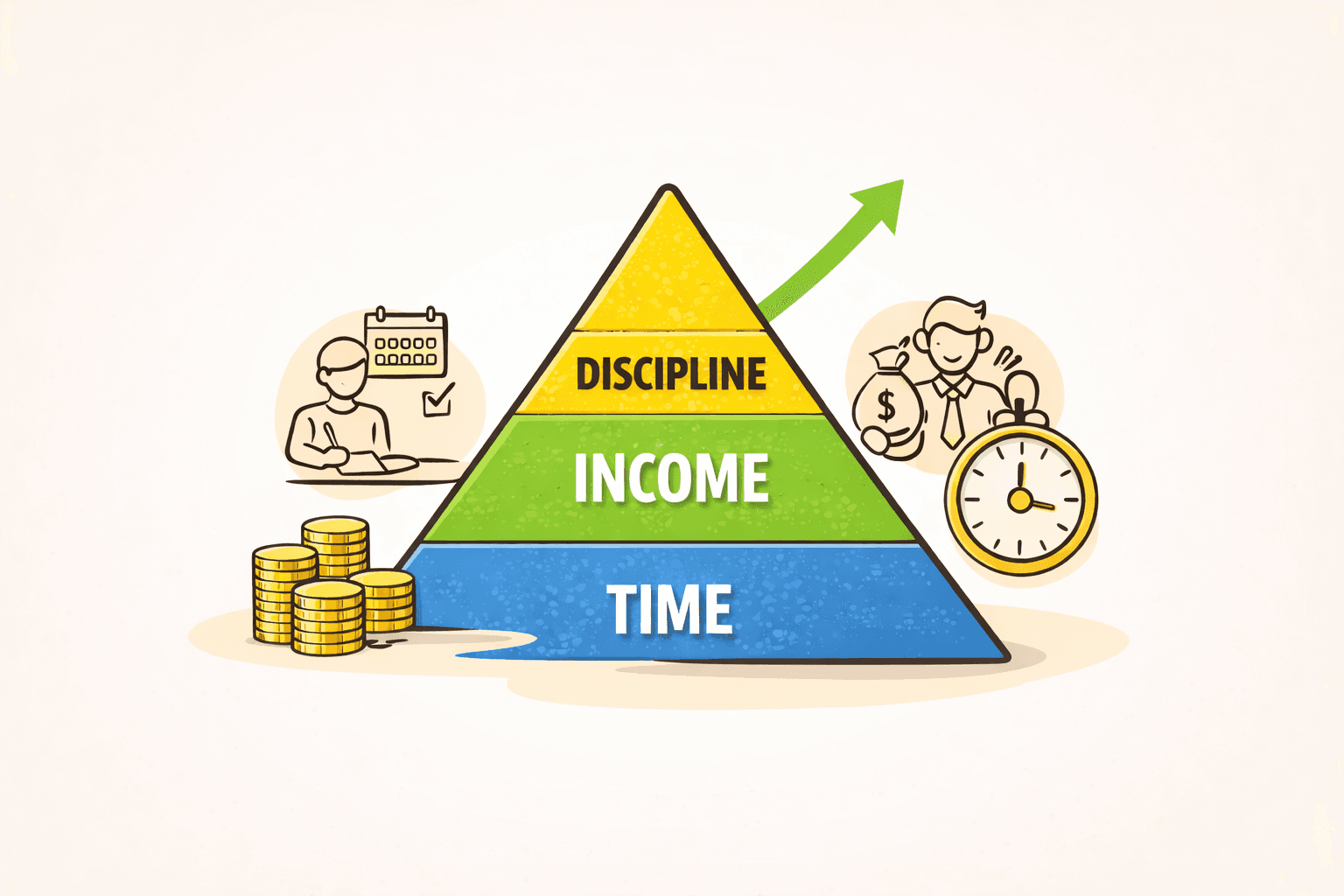
Warren Buffett, your grandmother with her savings account, and your coworker who never has anything left over at month's end — they're all working with the same three ingredients.
The difference? How they mix them.
Today we're going to talk about a simple equation that explains why some people build wealth and others don't — even when they earn the same amount.
Money vs. Wealth — What's the Difference?
This is a crucial distinction that most people don't understand.
Money (income) = what hits your bank account every month. Your paycheck, bonuses, side hustles.
Wealth = what you've built. Investments, real estate, savings. What remains even if you stop working tomorrow.
You can earn $150,000 a year and have zero wealth — because you spend it all.
And you can earn $50,000 a year and have millions in 20 years — because you understand the equation.
Income makes you rich on paper. Wealth makes you truly free.
The Wealth Equation
It's simple:
WEALTH = DISCIPLINE + INCOME + TIME

Three ingredients. No magic.
- Discipline — consistency, regularity, the ability to stick to a plan
- Income — how much you can invest (not how much you earn!)
- Time — how long you let your money work
And here's the key insight:
When you weaken one component, you must strengthen the others.
Don't have a high income? You need more time and iron discipline.
Starting late? You need higher income or larger investment amounts.
No discipline? Then you've got a problem — because without it, the equation doesn't work at all.
Component #1: Time
Time is the only component you can't buy, negotiate, or hack.
Every day you delay costs you more than you think. Compound interest needs time to get going — the first few years look boring. But then...
A Simple Example
The examples below are illustrative projections. They assume an 8% average annual return — a deliberately conservative figure, since the S&P 500 has returned about 10.5% per year nominally (roughly 7% after inflation) since 1926 (Official Data Foundation). Real returns are never this smooth year to year, but over decades the average is what compounding rewards.
Two people invest $500 per month at that assumed 8% annual return:
| Who | Starts at | Stops at 60 | Total Invested | Ends With |
|---|---|---|---|---|
| Sarah | Age 25 | Age 35 (then stops) | $60,000 | $680,000 |
| Mike | Age 35 | Age 60 | $150,000 | $520,000 |
Sarah invested 2.5× less money and has more. Why? Because she had a 10-year head start and then let compound interest do its work.

Time isn't just important. It's irreplaceable.
Component #2: Income
Obviously — the more you earn, the more you can invest. That makes sense.
But watch out for the trap: higher income often means higher expenses.
New car, nicer apartment, fancier restaurants... Lifestyle has a tendency to grow along with your paycheck. It's called lifestyle creep and it's the silent killer of wealth.
It shows up in the national numbers, too: as of June 2026, the U.S. personal saving rate was just 2.7% (FRED, Federal Reserve Bank of St. Louis). Most households are converting almost none of their income into wealth — which is exactly the gap this equation is built to close.
What Works
When you get a raise or bonus:
- Add the first 50% to investments — before you get used to having it
- Enjoy the rest — guilt-free
This way you gradually raise your standard of living, but at the same time you accelerate wealth building.
It's not about having the highest income. It's about how much of it you can systematically convert into wealth.
Component #3: Discipline
This is the component that separates those who build wealth from those who just dream about it.
You can have:
- 30 years of time
- A great income
- And still have nothing
How? Simple. Just invest inconsistently. Sometimes yes, sometimes no. "This month just didn't work out."
Why Discipline Is King
Discipline does two things:
1. Eliminates Emotions
You don't worry about whether the market is up or down. Every month, the payment goes through. Done. With regular investing (dollar-cost averaging), you sometimes buy high, sometimes buy low — and the average works out well.
2. Builds Habit
The first year is hard. The second year it's routine. By the third year, you don't even notice you're doing it.
Again, I'll quote my favorite idea from "Rich Dad, Poor Dad":
Pay yourself first!
How It Works in Practice: The Average American
Let's take Jake. He's 30 and earns roughly the median U.S. salary. As of Q2 2025, the median full-time worker earned $1,196 per week — about $62,000 a year (U.S. Bureau of Labor Statistics), which works out to roughly $4,200/month after taxes. Jake wants to start building wealth.
Jake's Equation
| Component | Jake's Situation |
|---|---|
| Time | 35 years until retirement — solid |
| Income | Average — room for optimization |
| Discipline | None yet — needs to start |
Jake calculates that he can invest $500/month (about 12% of his take-home pay).
What Happens in 35 Years?
With an 8% average annual return (again, an illustrative projection — actual returns vary year to year):
- Total invested: $210,000 (income converted to investments)
- Portfolio value: ~$1,050,000 (wealth)

See the difference? Jake put in $210,000 — but his wealth is over $1 million. That extra $840,000 is the work of compound interest. That's the magic when you add time and discipline to the equation.
But what if Jake had started 10 years earlier?
- Total invested: $270,000 (an extra $60,000)
- Wealth: $2,100,000 (double!)
Those 10 extra years = over $1 million difference.
Find Your Balance
Here's the important thing nobody tells you:
There's no single right ratio. There's only one you can actually stick to.
Different Life Situations
| Situation | What Changes | How to React |
|---|---|---|
| Baby arrives | Less money for investing | Lower the amount, but don't stop |
| Better job | More income | Increase investments before you get used to the extra cash |
| Unexpected expense | One-time hit | Keep going, one month means nothing |
| Promotion | More money, less time | Automate, so you don't have to think about it |
Life changes. And your equation can change with it.
My Experience
It took me several iterations to find a system that works for me.
First attempts were... let's say optimistic. "I'll invest 50% of my income!" Lasted two months.
Then I tried the opposite. "I'll invest what's left over." Nothing was ever left over.
What works:
At the end of every month, I look back. What worked? What didn't? Do I need to adjust the amount? Is there something I can automate?
It's not about finding the perfect system right away. It's about finding a system you can stick to — and then fine-tuning it over time.
Changes come. Better job, new expenses, different priorities. And that's okay. What matters is that the basic habit — that discipline — remains.
Which Component Should You Strengthen?
Quick test:
Are you young (under 30)?
→ Your biggest weapon is time. Even a small amount now beats a large amount 10 years from now.
Do you have an average income?
→ Focus on discipline. Regular $300/month beats random $1,000 here and there.
Starting late?
→ You need to increase your income or investment amount. No one can give you time back — but you can compensate with larger volume.
The Bottom Line
Building wealth isn't about luck or a high income.
It's a simple equation:
WEALTH = DISCIPLINE × INCOME × TIME
Three components. When one weakens, you strengthen the others. When life throws obstacles, you adjust and keep going.
Income makes you a person with money.
The equation makes you a person with wealth.
And a person with wealth is free. That's what matters.
Have questions? Email me at dennis.vymer@myfinancialfreedomtracker.com.
Stay updated
Get notified when we publish new articles.
Ready to apply this?
Start tracking your finances today and put these tips into practice.
- Import bank statements in seconds
- AI-powered categorization
- Beautiful visualizations
- Set and track financial goals
Related posts

Your Job Is the Biggest Position in Your Portfolio. I Diversified Everything Except the Thing That Pays for It.
My world ETF is spread across an entire developed-market index, and every euro that buys it comes from one employer, one country, one currency. Your job is the biggest undiversified position you own. Here is what actually reduces the risk, and why seven income streams does not.
How to Stop Arguing About Money With Your Partner: Our Money Date Is Twenty Boring Minutes Because Nothing Is Left to Decide
Our monthly money date takes twenty minutes and it's deeply boring, and for years I thought that was because we're good at talking about money. It isn't. Half of couples avoid the conversation on purpose to keep the peace, and every article tells them to talk more. Here's the opposite case.

One Spouse Manages All the Finances in Our House. It's Me, and That's a Design Flaw.
In our house, one spouse manages all the finances, and it's me. I built the tool, I buy the ETF, I read the numbers out loud while my wife listens. That's a bus factor of one. Here's the 30-minute quarterly drill we run instead of a password folder, and why documents rot.