When the Market Drops, I Do Nothing. Not Because I'm Disciplined, But Because I Deleted the Decision.
 Dennis Vymer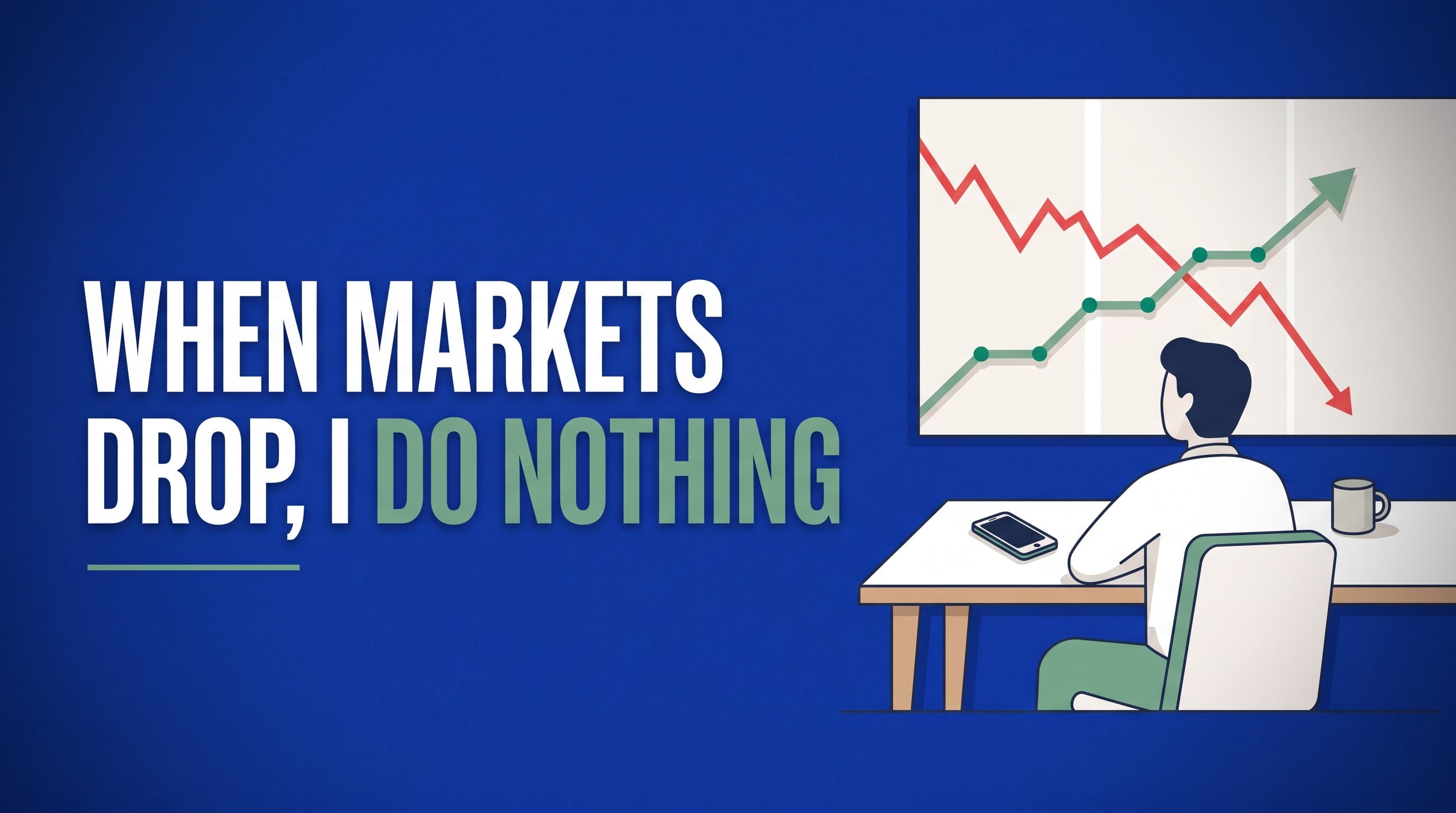
I found out about the 5 June sell-off on the Monday, at lunch, from a colleague who wanted to know if I was alright.
I was fine. I hadn't looked. On the Friday the S&P 500 had fallen 2.6%, the Nasdaq 4.2%, the semiconductor ETF had its worst day since March 2020, and about $1.8 trillion of S&P 500 market value went missing in one session, while I was in meetings about something else. So my honest answer to what to do when the market drops is that I did what I do every month, which is nothing, the nothing had already happened automatically, and I only learned afterwards there had been something to have feelings about.
That is not discipline. "Stay the course" is usually written in the voice of a man describing his own character. I don't have the character. I have documented proof that I don't have it.
The genius phase
I got lucky on Tesla early, back when owning it was still a slightly odd thing to admit to. The money was small by any adult standard. The damage was not, because what the win bought me was a quiet belief that I could read markets.
So I went looking for the next one, and the next one was crypto. I put roughly a third of my net worth at the time into Cardano. In today's terms that amount is almost nothing. Back then it was basically everything I had. Did I know anything beyond what Google told me over a couple of evenings? No.
It doubled in the first few months. I patted myself on the shoulder. The genius strikes again.
Then it fell 10x and more in a matter of days, and it never came back.
I still own that same position, on purpose; the full version of that story is here. It's the only line in my portfolio that's there as furniture. Once a month I scroll past my own ego, sitting in the account, still down, and I'm reminded to stick to the breathtakingly exciting strategy I actually run: spend less than we make, put the difference into one world ETF, repeat. The hard part is doing that for a decade without your ego taking the wheel because you read an article or watched a video by a man in a rented Lamborghini.
Buying the dip is panic selling in a nicer suit
Here's the position, and it's the part most people disagree with.
Panic selling and buying the dip are the same muscle. Both start from the conviction that today is special and requires you personally to do something. Both need you right twice. Vanguard says this plainly about selling, that you have to get "two timing decisions correct", when to exit and when to come back. Nobody notices the dip-buyer has the same problem: be right that this is a dip and not the first 15% of a 35% one, then right about how long to have waited.
Nick Maggiulli ran the fantasy version on a century of US data: buy $100 of the index monthly for 40 years, versus hoarding cash and deploying it only at the exact bottom between two all-time highs, with perfect foresight. The omniscient dip-buyer still loses to plain monthly buying more than 70% of the time. Miss the bottom by two months and it loses 97% of the time. There are far more all-time highs than bottoms, and you wait in cash while the market compounds.
I find that funnier than I should.
The evidence for my own thesis is messier than I'd like
The stat everyone reaches for is the behaviour gap. Morningstar's Mind the Gap 2026 found US investors earned 8.7% a year over the decade to end-2025 while the funds they owned returned 9.9%: 1.2 percentage points donated annually to their own timing, across roughly 23,000 funds and ETFs.
I'd love to stop there. I can't, because in May 2026 four researchers re-ran Morningstar's own sample in the Financial Analysts Journal and found bad timing costs investors 0.10% a year. Same data, order of magnitude apart. If you only ever see the 1.2% figure quoted at you, now you know the other half exists.
Morningstar add the line nobody quotes: regular investing and rebalancing create measured gap, so the study is "not advisable to view as a parable of 'dumb money'." My own payday automation shows up in that statistic as a defect. Fine. I went through the whole argument in the investor return gap.
What survives the rebuttal is the bit that's actually about me.
 Data: Morningstar, Mind the Gap 2026.
Sort funds by how much they move. In the calmest quintile, investors captured nearly all the return, a gap of 0.4 points. In the wildest, the funds made 8.0% a year and the people in them made 5.8%. Morningstar's phrasing: volatile funds "appear to push investors' buttons."
Then the number that made me sit back. Spot bitcoin ETFs returned 8.5% a year from January 2024 to mid-2026. The average dollar in them lost 5.8% a year. Same product. The money arrived after the run and left into the fall.
That's my Cardano story with a sample size. I wasn't uniquely stupid. I was in a thing that moved a lot, and things that move a lot extract decisions from you. My decisions were worth less than nothing.
What to do when the market drops, in our house
Nothing, and the nothing is load-bearing.
Money leaves our account on payday, before either of us has an opinion about anything. It buys one accumulating world ETF through Interactive Brokers, every month, with a small tech tilt I've never fully justified. A red month means that month's purchase was cheaper. That is the entire emotional content of a crash for us. If you want the version of what to do when markets crash that isn't just one guy's habits, we wrote that one too.
The feeling this produces is not calm, exactly. It's closer to emptiness. You read that the market fell 4%, your body files it as an event, events are supposed to be followed by actions, and there isn't one available. That emptiness is the system working. It took me years to stop reading it as cowardice.
My wife has never once asked me about a drop. We've had a couple of roughly 10% falls that were very visible in our numbers, and we walked past them, because we agreed on the destination long before we agreed on any mechanism, and a price move doesn't touch the destination.
The Buffett line is the one I use: you haven't lost anything in a fall as long as you don't sell. Through the ETF we own a tiny slice of an enormous number of companies, and unless the world economy is permanently over, that slice is fine. If it isn't, my portfolio won't be the headline that week.
The honest distinction isn't action versus inaction
Now the counterargument I think is genuinely strong, because leaving it out would make this a worse piece.
Vanguard, the same people I quoted about two decisions, recommend directing new cash, dividends and interest into whichever asset class is underweight. That is buying the dip. Structurally, it's the same trade. Their own illustration: a 60/40 portfolio left alone from end-2003 would have drifted to 80% equities by end-2022. Doing literally nothing forever is its own unexamined bet.
So the line isn't between acting and not acting. It's between decided in advance and decided in the moment. A rebalancing band is written down, it's boring, and it fires whether or not you feel clever that week. That's a plan. Opening your broker app because a headline scared you and calling it "buying the dip" is a mood with a spreadsheet taped to it. Rebalancing on rules and what I did with Cardano differ only in when the decision got made.
The one exception I allow myself lives inside that rule. If a month leaves genuinely spare cash, more goes in. Not because something fell; sometimes it's a month when everything went up. Vanguard's own work says getting money invested faster beats drip-feeding about two-thirds of the time, and they're careful that the finding is about windfalls, not regular monthly contributions from income. Bringing a contribution forward is the lump-sum case. Raiding the emergency fund to be a hero is a different sport.
The thing I would actually act on
Not the size of a fall. Never the size of a fall.
What I look at is where our money is exposed, by region and by sector. The seven biggest US companies are now about 34% of the S&P 500, a share that has nearly tripled in under a decade. A world ETF is not the neutral object people assume, and an index fund is not automatically diversified. On 5 June the index fell 2.6% while semiconductors fell 10%; that's concentration doing what it does.
I check that view in the tracker I build, which is my own product, so weigh it accordingly. What would move me is a region collapsing for political or geopolitical reasons — a war, a democracy converting itself into something else. That's a permanent change in what I own, not a price. A 20% drawdown is not information. A country changing its rules is.
 Data: Hartford Funds, S&P 500 bear markets since 1928.
There have been 27 bear markets in the S&P 500 since 1928, averaging a 35% decline over about 9.6 months, one every three and a half years. Over a normal investing life, expect fourteen. Something that happens fourteen times isn't an emergency. It's weather.
The cash I refuse to deploy
We keep six to twelve months of essential spending in a high-yield savings account, and more than a year of runway once you count everything, and that is exactly the cash every commenter tells you to shovel into a dip. I don't. It's oversized on purpose, and the day I start seeing it as ammunition is the day it stops doing its job.
What to do when the market drops, if you need an instruction
Open the tracker less, not more. A drop is the one moment I look at ours least.
That sounds like avoidance. It isn't. I know what we own, the plan is written down, and nothing in a bad week changes a plan built for decades. Looking more often just hands you more chances to have an idea. In 2020, when US markets fell 34% in five weeks, 83% of retail households at Vanguard didn't place a single trade. Fewer than one in two hundred went all the way to cash, and of those, about 86% were worse off by the end of May than if they'd left the February portfolio alone. Note where the damage came from: not the fall, the recovery. The people who got hurt weren't the ones who felt nothing. They were the ones who acted on it.
Everyone has spent 2026 braced for the crash. It hasn't come. The S&P 500 is up around 11–12% on the year with 27 record closes behind it, and on the September day the headlines read "stocks slide", the index sat about 1.4% off its 52-week high. A year can hold genuinely violent days and still be a good year. That's the most ordinary fact in investing and the hardest to keep in your head while the headline is on your screen.
So I'll keep buying on payday, I'll keep the little Cardano position, and in six or seven years I'd like to be working four days a week with my Wednesdays free. None of that is a market call, which is rather the point.
If I've built this right, the next crash will be the least interesting thing that happens to me that month.
Stay updated
Get notified when we publish new articles.
Ready to apply this?
Start tracking your finances today and put these tips into practice.
- Import bank statements in seconds
- AI-powered categorization
- Beautiful visualizations
- Set and track financial goals
Related posts

When the Market Drops, I Do Nothing. Not Because I'm Disciplined — Because I Deleted the Decision.
The market fell in September and I did nothing. Not out of discipline — there was no decision left to make. Why I think buying the dip is panic selling with better manners, and the one exception I allow.

Health Is the One Asset in Our FIRE Plan I Can't Buy Back at 40 — and This Year I've Been Quietly Spending It
Health and skills compound like the ETF does, and they're the only assets in our FIRE plan I can't buy back at 40 with a bigger number. This year, the first baby year, is the first time I've run a real deficit on one of them. No morning routine at the end.
I Never Sold My Wife on FIRE. I Sold Her a Free Wednesday.
Six months before the wedding we opened every account to each other. It was tough. What we never did, then or since, was say the word FIRE. Eight years on, I still think buy-in is agreement on a Wednesday, not agreement on a number.