I Bought the Same Fund Again This Month. The Boring Middle of FIRE Is the Only Part That Decides Anything.
 Dennis Vymer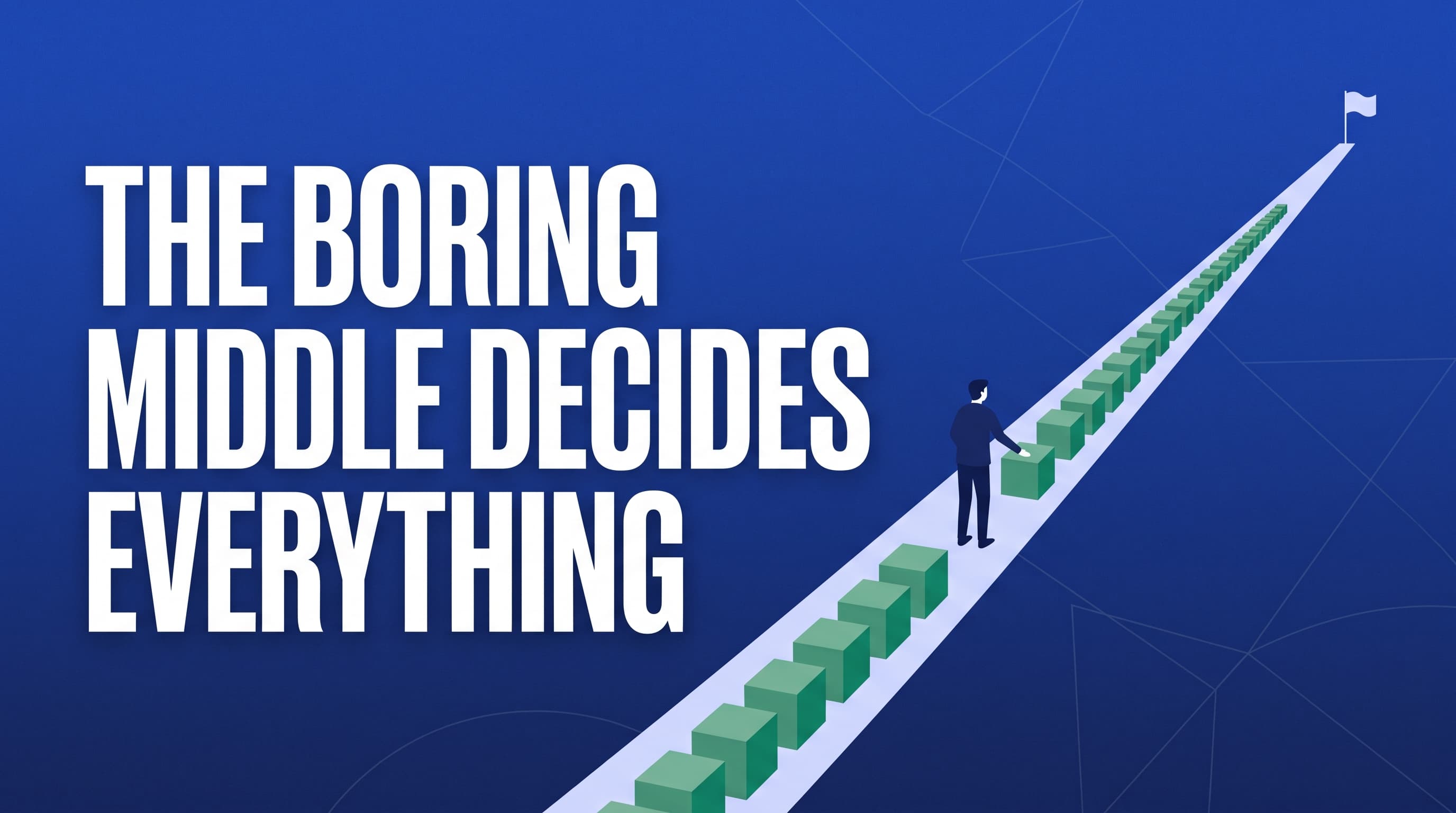
The purchase took about forty seconds, and most of that was the two-factor code. Same world ETF, same day of the month, same amount, out of the account before I'd had a chance to form an opinion about it. I've done that every month for years and I intend to keep doing it for years more, which puts me in the part of FIRE nobody writes a guide for: the boring middle, where the number is too big to feel new and too small to feel finished.
There was no feeling attached to it. Not pride, not virtue, no montage music. I closed the tab and went to make a bottle.
We're roughly a quarter of the way to the number we actually care about. The plan says nothing is supposed to change for about a decade. Our daughter is three months old, and by the time this thing is done she'll be in school. That's a long stretch to keep repeating an action that generates no news, and the two best-written pieces on the subject both tell you the way through is to be a certain sort of person. One of them says, in as many words, that he has the genes of a disciplined person.
I think that's wrong, and I think it's why people quit.
The boring middle is not a discipline problem. It's a design problem.
FIRE gets written about at both ends and lived in the boring middle
Look at what the genre actually publishes. Everything is aimed at the beginner (how to open an account, what an ETF is, the first hundred grand) or at the finisher (withdrawal rates, sequence risk, the last day at work). Both ends are wildly over-served relative to how much of your life they occupy.
Baptiste Wicht, who writes The Poor Swiss and is ten years into his own run, puts his boring middle at roughly 30% to 90% of the way to financial independence. That's not an interlude. That's the film.
Run the arithmetic and it gets worse. At a 30% savings rate and a 5% real return, starting from nothing, you're looking at something like 28 years. At 40% it's 22. At 50% it's 17. Even at the aggressive end, the gap between the article about starting and the article about stopping is well over a decade of doing the identical thing.
 Computed illustration, not a forecast. Starting from zero, target 25x annual spending, spending = (1 - savings rate) x income, income flat in real terms, taxes and fees ignored.
And the far end doesn't repay the gritting. There's a widely shared post from 2025 by someone who hit three million: he noticed he'd hit his number, thought "cool," and went to boot up the PS5. Hundreds of replies said the same thing. That's a story, not evidence, but it keeps showing up, and it's the only honest preview of the finish line most of us will get.
The boring middle is where the scoreboard stops reporting on you
Here's the mechanic nobody in this genre prints, and it's arithmetic rather than psychology.
In year one, every euro of growth in your account is a euro you earned and deposited. You are the compounding. I wrote about that phase in why the first $100k is the hardest: effort and the number move together, and the feedback loop is honest.
That loop breaks. At a 5% real return with a steady contribution, your own money supplies 100% of the portfolio's growth in year one, about 64% in year ten, and under 40% by year twenty. Somewhere around year sixteen the market permanently out-contributes you, and from then on the balance is mostly a readout of what happened in Tokyo and San Francisco last quarter.
 Computed illustration, not market data. Constant real contribution, 5% constant real return, contributions at year end, starting from zero.
Nothing about the saver changed. The instrument did. You're still putting in the same share of your pay, with the same stubbornness, and the number on the screen has stopped being a report on you and started being a report on the world.
Marc Pittet at Mustachian Post publishes his net worth, which is braver than most of us, and his track has the whole argument in it. Early 2016 he's at CHF 207,000. Early 2017, after a full year of saving hard and doing everything right, he's at CHF 217,000. Ten thousand francs, for a year of his life. Later in the same published track, five years add roughly one and a half million francs to that household. His behaviour didn't change between the two stretches. Only the size of the base did.
If you read a year like his 2016 as a grade on your effort, you will conclude you are failing at something you are actually doing perfectly.
A plan that only works while you're motivated is already broken
This is where the genre reaches for willpower, and I'm not going to, because I went and checked.
The story I grew up on was that discipline is a tank that empties, so ten years drains anyone. Great line. It also failed the biggest test anyone has run on it: 23 laboratories, 2,141 participants, preregistered, and the ego-depletion effect came out at d = 0.04 with a confidence interval sitting right on top of zero. So I can't tell you your willpower runs out, because the evidence says it probably doesn't work like that at all.
What actually happens over ten years isn't depletion. It's events. A baby. A redundancy. A parent who gets ill. A quarter where the market takes a fifth of everything and your brother-in-law asks how the investing is going. You don't lose your resolve. You get handed four things at once that all need a decision, and the plan is one of them.
There is a version of this visible at national scale. In 2022 the world index fell 17.73%. German retail investors did not cancel their ETF savings plans that year. The count went up, from 3.32 million to 3.76 million. What fell was the amount: the average monthly instalment went from €181.60 in 2021 to €166.90 in 2023, a cut of about 8%, and it took until 2026 to crawl back to where it started.
 Data: extraETF Research, ETF-Marktstatistik, March 2026. Sample of participating German direct banks; instalment figures are annual averages.
Nobody in that data quit FIRE. Nobody announced anything. Several million people just paid themselves a bit less every month for three years, and I doubt one of them called it a decision, which is exactly what a motivation-dependent plan looks like when the motivation goes.
Not a dramatic exit. A quiet trim.
Which is why I think almost everything written about the boring middle is aimed at the wrong layer. "Find your why", "think long-term", "stay the course" are motivation fixes for a design fault, and they work exactly as long as you happen to feel like it. The question worth asking isn't how to stay motivated for a decade. It's what your plan does on the months when you aren't.
The design answers are unglamorous and they come with coefficients attached. Benartzi and Thaler's Save More Tomorrow took savers from a 3.5% to a 13.6% savings rate in slightly under four years by pre-committing future increases to future raises, so nobody's take-home ever dropped and nobody had to feel inspired on a given Tuesday. And Vanguard found that participants who were confident they could cover a $2,000 emergency were 43 percentage points less likely to cash out their entire retirement balance when they changed jobs, which beat "three months of expenses" as a predictor. Two thousand of whatever currency you use, sitting boringly in cash, protects a decade of investing better than any amount of resolve. And it matters just as much what the decade is for. A plan shaped like an escape hatch is the hardest to hold, because every uneventful month becomes time served rather than time lived, and hating your job is not a plan.
The calmest investors didn't have better nerves
Morningstar publishes an annual study comparing what funds returned with what the average invested dollar actually earned. The headline number gets quoted everywhere. I'm going to skip it, for a reason I'll come to.
The interesting part is the cross-section. Over the ten years to the end of 2025, across roughly 23,000 US funds and ETFs, the most volatile quintile of funds gave up 2.1 percentage points a year to timing. The least volatile gave up 0.4. And the large-blend category, the plainest and most widely held thing in the entire study, had a gap of exactly zero. Investors earned 14.0% a year. The funds earned 14.0% a year.
 Data: Morningstar, Mind the Gap 2026.
Volatility predicted the gap better than fees did. ETF owners had a wider gap than mutual fund owners despite earning more, because the thing built for flexibility works best when the flexibility never gets used.
Read that as a statement about character and it says the large-blend crowd are calmer people. I don't believe that. They own something so uneventful that there's never an obvious day to do anything about it. The gap didn't close because they cared more. It closed because the product gave them nothing to react to.
About that headline number I skipped. It is genuinely contested: a paper in the Financial Analysts Journal this May reproduced the same sample and put the real timing cost at 0.10% a year rather than 1.2%, and Morningstar's own author has spent years telling people not to read his study as proof that ordinary investors are idiots. I went through that fight properly in the investor return gap piece. The cross-sectional findings survive either reading, which is exactly why I lean on them instead. If your fund choice moves your gap by two points a year and your fee choice moves it by less, that's a design finding no matter whose headline you believe.
Measure what you move, not what the market moves
Which brings me to the objection that nearly killed this article.
Harkin and colleagues ran a meta-analysis covering 138 experiments and 19,951 people, and found that monitoring your progress toward a goal genuinely promotes reaching it, d+ = 0.40. Better than that: the effect was larger when progress was physically written down, and larger again when it was reported to somebody else. Track more. Write it down. Tell someone.
I agree with all three. So I'm not going to tell you to check less, which is the standard advice here and which the evidence flatly contradicts.
I'm telling you to change the variable. Harkin is about monitoring progress on something you influence. Net worth in year twelve fails that test, because it's dominated by a number you don't move. Writing it down every week doesn't turn it into feedback, it turns it into weather reporting.
The things you actually move are your savings rate, whether the contribution went through on schedule, whether your income grew this year, and how many decisions your plan still leaves open each month. Those four deserve the full Harkin treatment: recorded, reviewed, said out loud to the person you live with. The savings rate carries more weight than the rest by a distance, which is why I've put it side by side with investment returns before. Net worth becomes a slow instrument. Not an ignored one. Checked at roughly the frequency you're responsible for it, which in year three is often and in year eighteen is not. That split is the readout I built into my own tracker and put on its own screen, because I wanted to watch the crossover happen rather than just feel vaguely worse about a line that wouldn't move.
The middle is where the money is meant to get spent
Ten years isn't a corridor between the good parts. It contains my daughter learning to walk, my own thirties, and my parents while they are still in good health. Treating it as a waiting room is how people arrive at the number holding a beautiful spreadsheet and a decade they can't remember.
Wicht, whose prescription I've been arguing with throughout, gets this part right: he bought a house and a car during his boring middle and says plainly that they are not delaying their life. Then, asked in his own comments which trap he actually fell into, he answers lifestyle inflation.
Both of those are true at once, and that ambivalence is more useful than a clean rule. A savoured upgrade and absorbed creep look identical at the moment of purchase. They only separate in hindsight. The only test I've found that works in advance is whether the thing was decided ahead of time, priced into the plan, and marked permanent or one-off, because a permanent upgrade quietly raises your number and your date and almost nobody writes that down at the till. We ran exactly that decision on a car we didn't buy, and I'm still driving the Golf.
One booked, savoured, deliberately expensive thing a year. Decided in January while sober, not at 11pm in a browser tab full of SUVs.
Ten years of the same choice is a two-person project
A decade needs two people who both still agree, and the one who didn't build the model has to be able to see the middle too.
That's most of what our monthly ten minutes is for. Not data entry. Making sure the plan isn't something one of us is doing to the household. Once a year we open the whole thing and ask whether we still want it, out loud, with a real no on the table. A partner who agreed in 2021 is not the same thing as a partner who agrees now, and the difference tends to surface about eight years too late.
Where this argument is weakest
Four places, and I'd rather say them than have someone say them for me.
The first is the strongest. "Design it so you can ignore it" sits one bad year away from "ignore a plan that has gone stale". If nobody ever looks, nobody notices that your income doubled while the standing order didn't, or that the target was set for a life you no longer have. My answer is a dated annual drift check with three questions: has income moved without the contribution moving, has spending drifted, is the target still right. If that review isn't in the calendar, I'm not designing anything. I'm coasting and calling it a system.
Second, the arithmetic of spending in the middle is brutal. Dropping from a 50% savings rate to 40% adds roughly five years on the same assumptions as the chart above. Five years is not a rounding error, and "spend deliberately" is a phrase that can absorb an enormous amount of self-deception.
Third, plenty of people are holding the line just fine without any of this. Vanguard's 2026 data has 45% of participants voluntarily raising their savings rate, and only 5% trading at all during volatility. Maybe good design already caught them. Maybe some people genuinely like watching a number climb and none of this applies. If that's you, carry on.
Fourth, and this is the objection I like most, a commenter on The Poor Swiss pointed out that for most people the middle isn't boring at all. It's a roller coaster of job insecurity, AI-driven layoffs, family illness and whatever else life posts through the door. Fair, and I'd go further: the middle isn't boring. The plan is boring, and it has to be dull enough to survive a decade that isn't.
What I actually do in the boring middle of FIRE
One purchase a month, automatic, into one broadly diversified fund I hold no opinions about. A buffer in cash I've never had to justify to a spreadsheet. Ten minutes together once a month, mostly to confirm nothing broke. One long session in January where we re-model the plan properly and are allowed to change it. One deliberate, priced-in upgrade a year. Four numbers I actually watch, none of which is the balance.
That's the whole system. It contains no willpower, and that isn't laziness, it's the specification.
The reason there's a projection in the tracker at all is that a decade of sameness is illegible without one. Drag one value, watch what it does to the next ten years, and the middle stops being fog and turns into something with edges. It doesn't make the months more interesting. It makes the boring middle legible, which turned out to be the thing I actually needed.
My daughter will be about ten when we hit the date on this plan, and even then we don't intend to stop working, just to stop having to. Not a beach. A Wednesday I get to decide about, and eventually, maybe, a room where I get to teach some maths. That's a decade more of a forty-second purchase to get there, and the only thing I'd insist on is that the decade itself be worth living rather than merely efficient.
This month's purchase was identical to last month's. So was the feeling. Good.
Stay updated
Get notified when we publish new articles.
Ready to apply this?
Start tracking your finances today and put these tips into practice.
- Import bank statements in seconds
- AI-powered categorization
- Beautiful visualizations
- Set and track financial goals
Related posts
FIRE Is Not an Escape Hatch. In 2026 That Is Exactly How Most People Are Using It.
Quits are at a decade low, global engagement is 20%, and FIRE is quietly absorbing everyone who won't walk through an open door. I like my job and still save half. Here's why an escape-shaped plan builds a worse portfolio than the same numbers.
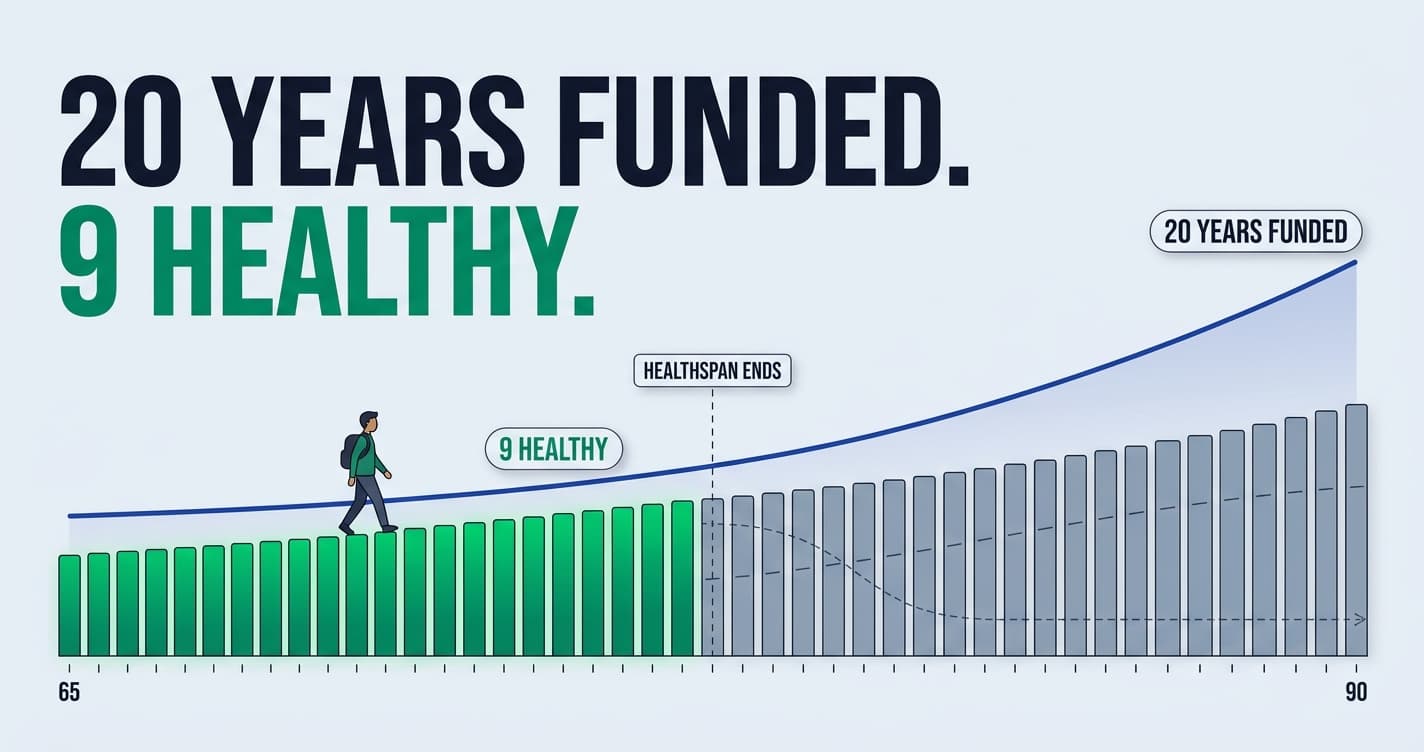
Healthspan vs Lifespan: My FIRE Plan Funds Me to 90 and Assumes a Body It Never Modeled
My projection argues about returns to a tenth of a percent and has no field for the body spending the money. At 65 in the EU you get 20 years, 9.4 of them healthy. Here's what healthspan vs lifespan does to a FIRE plan, and what a protected health line actually costs.
How Much Money Do I Need to Retire? The 25x Answer
You need about 25x your annual spending: $60,000 a year means $1.5M. The full table, where 25x comes from, and the age and pension adjustments.