Lifestyle Creep Examples and What They Cost Your FI Date
 Dennis Vymer
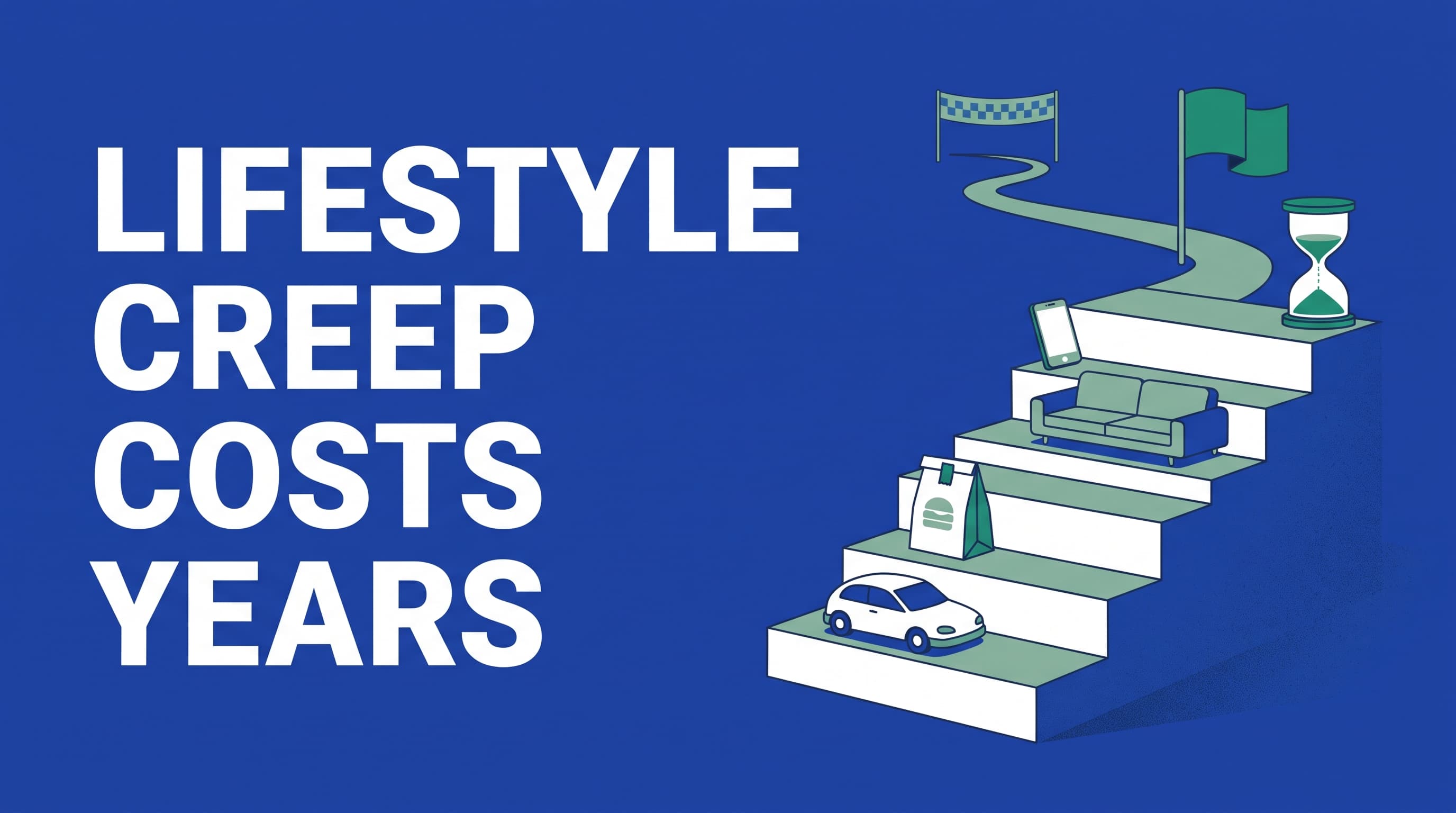
Lifestyle creep is when your spending rises with your income, so a raise leaves you no better off: a pricier home, a newer car, more delivery, more subscriptions. The hit is double, because every extra 100 a month spent for good also adds 30,000 to the pot you need (25x yearly spending). Save at least half of each raise. Spend all of it, and financial independence can arrive later than with no raise.
Every figure below, seven priced examples and one raise worked three ways, comes from one household with round, illustrative numbers that work in any currency. It earns 3,000 a month net, spends 2,000 and invests 1,000 from a standing start at a 5% real (after-inflation) return. Financial independence (FI) means 25 times yearly spending. Your own result moves with your savings rate: the less you save today, the harder each extra 100 a month bites, and the free FIRE planner shows the date for your own figures, no sign-up.
What lifestyle creep is, and how it differs from inflation
Lifestyle creep (also called lifestyle inflation) is spending that rises because your income rose, rather than because prices did. Inflation means the same basket of shopping costs more; creep means the basket itself changes. The two-bedroom place becomes a three-bedroom one, the ten-year-old hatchback becomes a leased SUV, and Tuesday dinner turns into delivery. When your spending grows faster than prices while the amount you invest stays flat, the gap between the two is creep.
In the EU, households in the top fifth by income spend about twice as much per adult as the bottom fifth (23,795 against 11,805 in purchasing-power units, Eurostat household budget survey, 2020). In the US the top fifth spent $159,512 in 2025, against $37,935 for the bottom fifth. Average spending rose 4.3% that year, while pre-tax income rose 6.4% (BLS Consumer Expenditure Survey). Bigger families and pricier cities explain part of that gap, and expectations play a role too: in Swiss survey data, Alois Stutzer found that 10% more household income goes with roughly 4.2% higher income aspirations, and higher aspirations go with lower life satisfaction.
7 lifestyle creep examples, priced per month and per FI target
Each row adds one permanent upgrade to the base household (3,000 net, 1,000 invested a month, FI target 600,000, reached in 25.3 years). The monthly amounts are round illustrative numbers, not price quotes. Every upgrade hits twice: each 100 spent is 100 less invested, and the target grows by 300 times the monthly cost (12 months x 25).
| Example | Extra per month | Per year | Added to FI target (x25) | FI date moves by |
|---|---|---|---|---|
| Housing upgrade (bigger or pricier home) | 500 | 6,000 | +150,000 | +14.9 years |
| Car upgrade (bigger loan or lease payment) | 300 | 3,600 | +90,000 | +7.7 years |
| Food delivery and eating out more | 200 | 2,400 | +60,000 | +4.8 years |
| Paid cleaning or home services | 150 | 1,800 | +45,000 | +3.5 years |
| Holiday tier creep (+1,800 a year) | 150 | 1,800 | +45,000 | +3.5 years |
| Subscriptions stacking (4-5 services) | 50 | 600 | +15,000 | +1.1 years |
| New phone or gadgets on every release | 50 | 600 | +15,000 | +1.1 years |
| Any 100-a-month habit (reference) | 100 | 1,200 | +30,000 | +2.3 years |
These amounts are modest, and the car row is only the difference between two payments. The average new-car loan payment in the US was $765 a month in Q2 2026 (Experian), so a 300 step up from an older car is easy to reach. The subscription row assumes four or five services at 10-12 each; Netflix alone charges $19.99 a month for its Standard plan in the US (Netflix help centre).
The delays don't add up in a straight line: the 500 housing upgrade costs 14.9 years, far more than five times the 2.3 years of a 100 habit, because it eats half of the 1,000 that was building the pot. All seven together come to 1,400 a month, more than this household invests, so on 3,000 net it would never reach FI. Even after a 500 raise, the household would invest only 100 a month towards a 1,020,000 target, which takes 76.9 years.
 Data: MFFT calculation; base household 3,000 net, 2,000 spent and 1,000 invested a month, 5% real return compounded monthly, FI target 25x yearly spending, base 25.3 years; each example added on its own as a permanent spending increase.
The worked example: what happens to one raise
Same household, and now it gets a raise worth 500 a month after tax. There are three ways to handle it: invest all of it, spend half, or spend all of it. Any part that gets spent is treated as permanent, so it raises the FI target too.
| Scenario | Spend per month | Invest per month | Savings rate | FI target (25x) | Years to FI | Compared with no raise |
|---|---|---|---|---|---|---|
| No raise (3,000 net) | 2,000 | 1,000 | 33.3% | 600,000 | 25.3 | baseline |
| +500 raise, 0% of it spent | 2,000 | 1,500 | 42.9% | 600,000 | 19.8 | 5.5 years earlier |
| +500 raise, 50% of it spent | 2,250 | 1,250 | 35.7% | 675,000 | 23.8 | 1.5 years earlier |
| +500 raise, 100% of it spent | 2,500 | 1,000 | 28.6% | 750,000 | 28.7 | 3.3 years later |
Spending the whole raise moves FI from 25.3 years to 28.7 years, about 40 months later than if the raise had never happened. The household still invests 1,000 a month, exactly as before. But the target has grown from 600,000 to 750,000, so the same deposits have further to go. A fully spent raise lands later than no raise at any return you pick, because savings stay put while the target rises; the return only changes the size of the delay. To test your own numbers, put what you live on, what you have invested and what you add each month into the free FIRE planner. Set the annual return to the figure you believe in, then raise the spending by whatever an upgrade would cost and compare the two dates. Splitting the raise down the middle keeps most of the benefit (23.8 years), and investing all of it gets there in 19.8 years. All four rows hold the return at 5% and change only what is saved; savings rate vs investment returns compares the two levers directly.
How the numbers were made, so you can check them: a 5% real return a year, compounded monthly (1.05^(1/12) − 1, about 0.407% a month), with deposits at the end of each month and a start from zero. The target is 25 times yearly spending, the 4% withdrawal rule from Bengen's 1994 study. 5% real is below the roughly 7% the FIRE planner's FAQ suggests for stock-heavy portfolios, and above the 3.5% a year that global stocks returned after inflation from 2000 to 2024 (UBS Global Investment Returns Yearbook 2025). Money already invested shortens every delay in this article, so if you are not starting from zero, treat the years as an upper bound.
 Data: MFFT calculation; 3,000 net and 2,000 spent a month before the raise, +500 a month raise, 5% real return compounded monthly, start from zero, FI target 25x yearly spending.
Signs lifestyle creep is already happening
- Your income went up in the last two years, but your savings rate (invested ÷ net income) stayed flat or fell.
- One or more spending categories grew faster than inflation. Divide this year's total by last year's for each category; anything well above your country's inflation rate came from choices, since prices alone don't explain it.
- Your list of necessities is longer than it was two years ago: a second car, a cleaner, three streaming services, a gym plus a home-workout app.
- A raise was gone within three months and you can't say where it went.
- Fixed monthly payments (leases, instalments, memberships) take a bigger share of your income than before the raise.
Creep shows up as a category trend over 12 months, which a single month's budget won't catch. You can track spending by category month over month in My Financial Freedom Tracker and look at which lines rose after your last raise. Disclosure: I build this one. If you have never tracked spending before, how to start a budget covers the basics first.
How much lifestyle creep is okay?
A workable rule: invest at least half of every raise, permanently, from the month it arrives. In the worked example that still brings FI 1.5 years earlier than no raise and leaves 250 a month for upgrades you will actually notice.
Some creep is the point of earning more, and there is data behind that: in a study of more than 6,000 people in the US, Canada, Denmark and the Netherlands, those who paid to save time, on cleaning or errands, reported higher life satisfaction after controlling for income. In a field experiment, $40 spent on a time-saving purchase made people happier than $40 spent on a material one (Whillans et al., PNAS 2017). A cleaner at 150 a month costs this household 3.5 years, which can be a fair trade for a family that gets every Saturday afternoon back. The upgrades to catch are the ones nobody decided on: subscriptions that stack, delivery that turns into the default dinner, the car payment rolled straight into the next car.
For this household, a one-off 3,000 holiday pushes FI back by about 3 months, and a holiday budget that rises by 150 a month for good costs 3.5 years. The one-off comes out of savings once; the permanent rise cuts what is invested every month and raises the target at the same time.
Upgrades that tend to earn their cost are health, safety (a car with modern safety equipment, which needn't be the biggest model) and things that save money or time for years, like insulation or a reliable boiler. Upgrades that only reset the baseline are newer versions of things that still work. Before you sign up for anything that recurs, add its monthly cost to your spending in the FIRE planner and compare the two dates.
How to avoid or reverse lifestyle creep
- Split the raise on payday. Increase the standing order to your investment account by at least half of the net increase. Do it in the month the raise lands, before the money reaches your current account. Raising your monthly investment every year shows what that habit adds up to over a decade.
- Audit fixed costs once a year instead of relying on daily willpower. Insurance, energy, phone and internet contracts and subscriptions take one evening to review, and the savings repeat every month, which is how a fixed-cost audit beats cutting coffee.
- Upgrade when the old thing is used up, rather than when you can afford the new one. A car that still runs is the classic case; lifestyle creep after a baby, still driving the Golf works through that decision.
- To reverse creep, cut the recurring item and keep the treats. Cancelling one unused 50-a-month subscription is worth 1.1 years for the example household. Giving up a weekly coffee you enjoy saves a fraction of that and rarely lasts.
Pull the last 12 months of spending into a category view or a spreadsheet, find the two categories that grew most since your last raise, and put each one's before and after monthly totals into the FIRE planner to see how many years it adds.
Frequently asked questions
- Is lifestyle creep always bad?
- It is bad when an upgrade becomes permanent without anyone deciding on it. Spending more as you earn more is fine when you choose it and price it first: a cleaner or a safer car can be worth the years. In a household investing 1,000 a month towards 25 times yearly spending at a 5% real return, each permanent 100 a month delays financial independence by about 2.3 years, so decide which upgrades earn that.
- What is the difference between lifestyle creep and inflation?
- Inflation is the same goods costing more; lifestyle creep is buying different, pricier goods because your income rose. If the same weekly shop costs 5% more, that is inflation. If you moved from cooking to delivery three nights a week, that is creep. A quick check is to compare each spending category's yearly growth with your country's inflation rate; the excess mostly comes from choices.
- How much of a raise should I save?
- Invest at least half, automatically, from the month the raise starts. In a worked example with 3,000 net income, 1,000 invested a month, a 5% real return and a 25x target, a 500 raise spent by half brings financial independence in 23.8 years instead of 25.3. Invested in full it takes 19.8 years; spent in full it takes 28.7, later than with no raise.
- How do I reverse lifestyle creep?
- Cut recurring costs rather than small treats. List every fixed monthly payment, cancel or renegotiate the ones you would not sign up for again today, and move the freed amount into an automatic investment in the same month. For a household investing 1,000 a month at a 5% real return, each 100 a month of permanent spending removed brings the financial independence date about 2.3 years closer.
Stay updated
Get notified when we publish new articles.
Ready to apply this?
Start tracking your finances today and put these tips into practice.
- Import bank statements in seconds
- AI-powered categorization
- Beautiful visualizations
- Set and track financial goals
Related posts
Income Concentration Risk: Your Job Is Your Biggest Position
Your salary is the biggest undiversified position you own: one employer, one country, one currency. What actually reduces income concentration risk.
How to Stop Fighting About Money in a Relationship
Half of couples avoid money talks to keep the peace. Talking more isn't the fix: closing the open decisions is, so the check-in has nothing to fight over.
How to Calculate Net Worth (Formula + Worked Example)
Net worth is assets minus liabilities. What counts on each side, how to handle the house, pension and car, a worked example, and why monthly beats once.