VWCE vs VT: Which Vanguard World ETF Costs You Less?
 Dennis Vymer
VWCE vs VT comes down to where you live: a US investor should hold VT, which charges 0.06% a year against VWCE's 0.14%, holds about 10,000 stocks against 3,800, and avoids the PFIC paperwork a foreign fund brings. For an EU resident the all-in yearly cost is nearly a tie, about 0.29% for VWCE and 0.31% for VT, so access and tax make VWCE the practical pick.
The fee gap shrinks for Europeans because both funds lose 15% of their US dividends to withholding, just at different levels. VWCE, an Irish fund, pays it inside the fund on the US part of its dividends. VT pays out its whole distribution, which is withheld at 15% before it reaches you and is then taxed at home every year, usually with that 15% credited. On top of that, most EU retail brokers have not sold VT since 2018, when EU rules began requiring a key information document that US fund issuers did not produce, and holding it brings US estate-tax filing above $60,000. There is also a third option, VGLA/VALL, which tracks VT's index from Ireland for 0.07% (MFFT's VT UCITS equivalent page lists it next to the other Irish world funds), but it only launched in August 2026.
VWCE vs VT at a glance
| VWCE | VT | |
|---|---|---|
| Full name | Vanguard FTSE All-World UCITS ETF (USD Accumulating) | Vanguard Total World Stock ETF |
| Index | FTSE All-World (large and mid caps) | FTSE Global All Cap (large, mid and small caps) |
| Stocks held | 3,821 | 10,185 |
| Yearly fee | 0.14% | 0.06% |
| US weight | 62.2% | 62.4% |
| Domicile | Ireland (UCITS) | United States |
| Dividends | Reinvested (accumulating) | Paid out quarterly |
| Where it trades | Xetra, Euronext Amsterdam, Borsa Italiana in EUR; London as VWRA (USD) and VWRP (GBP) | US exchanges, in USD |
| Fund size | $87.3bn (all share classes) | $101.2bn (all share classes) |
| Retail buyers | Anyone at an EU broker | US investors; EU retail access blocked by PRIIPs |
Figures as of 30 September 2026, from Vanguard's VWCE factsheet and VT fact sheet.
What each fund costs you per year, by where you live
US companies pay dividends with US tax withheld, and an Irish fund like VWCE gets the treaty rate of 15% on those dividends (the US-Ireland rate in the IRS treaty table), and you can't reclaim or credit it, because the fund paid it. VT is itself a US fund, so for a European holder its entire distribution counts as a US dividend: 15% is withheld with a W-8BEN form, the treaty rate for most EU countries (Germany, France, Italy, Spain, the Netherlands and Czechia among them).
Inputs, all from fund and index documents dated autumn 2026:
- Fees: 0.14% (VWCE), 0.06% (VT), 0.07% (VGLA), from the Vanguard factsheets above and the VGLA factsheet.
- Dividend yield 1.63% and US weight 62.70% for the FTSE All-World index; 1.65% and 62.89% for the FTSE Global All Cap index (FTSE Russell, 30 October 2026).
- Irish fund: cost = fee + US weight × yield × 15%. For VWCE that's 0.14% + 0.627 × 1.63% × 15% = 0.293%.
- VT held from Europe: cost = fee + yield × 15% = 0.06% + 1.65% × 15% = 0.308%, before any tax at home.
| Investor and fund | Fee | Lost to US withholding | Total per year | Per 10,000 invested |
|---|---|---|---|---|
| EU resident in VWCE | 0.14% | 0.153% | 0.293% | €29.33 |
| EU resident in VGLA (VT's index, Irish) | 0.07% | 0.156% | 0.226% | €22.57 |
| EU resident in VT, before local tax | 0.06% | 0.248% | 0.308% | €30.75 |
| US resident in VT | 0.06% | none | 0.06% | $6.00 |
| US resident in VWCE (PFIC rules not costed) | 0.14% | 0.153% | 0.293% | $29.33 |
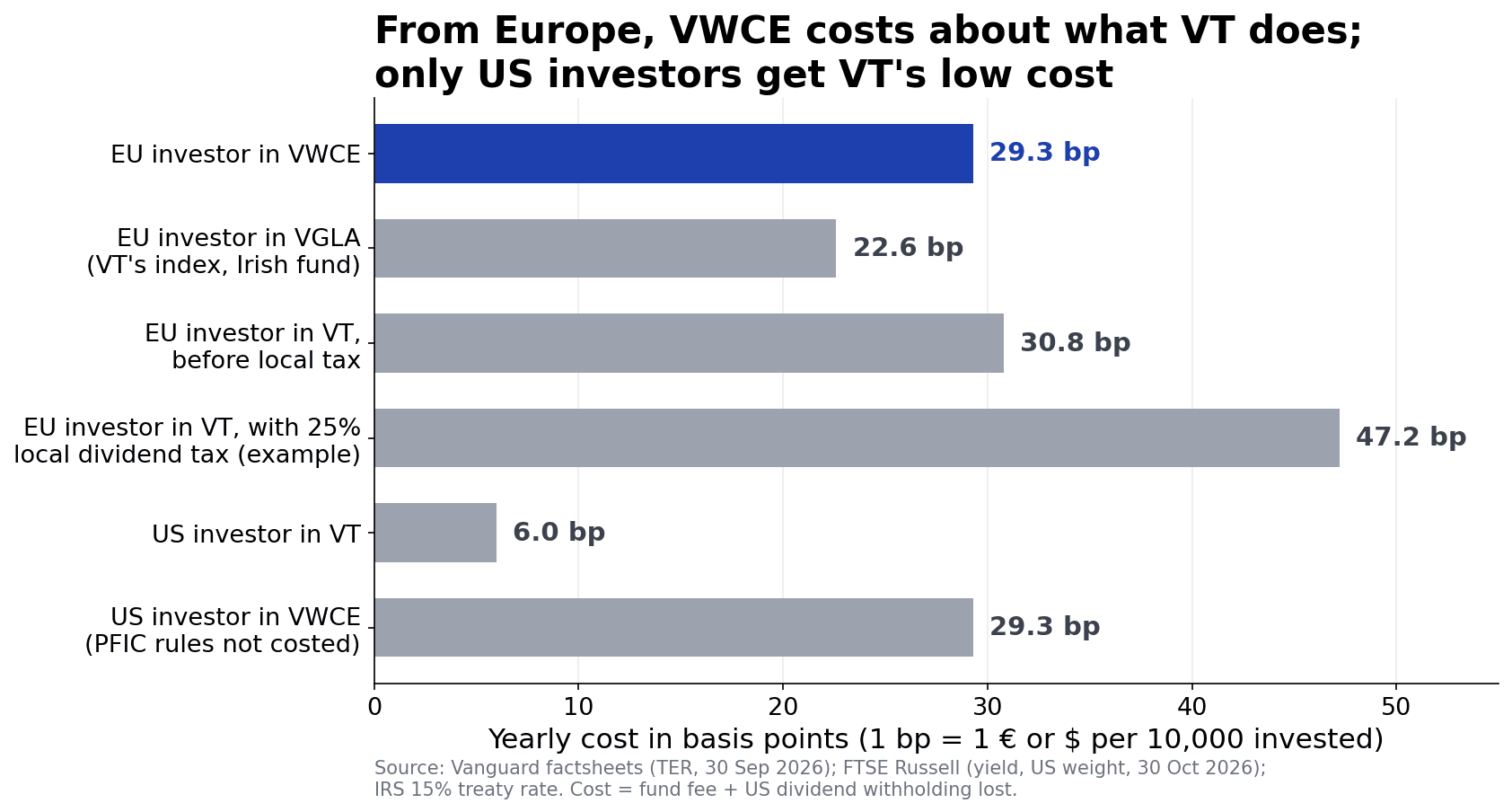 Data: Vanguard factsheets (fees, 30 Sep 2026), FTSE Russell (dividend yield 1.63% / 1.65%, US weight, 30 Oct 2026), 15% US treaty withholding (IRS). Cost = fund fee + US dividend withholding lost; the 25% local tax bar is an example rate.
The VWCE line is slightly too high, if anything: US stocks yield less than the world average, and VWCE's own factsheet shows an equity yield of 1.5%, below the index's 1.63%. Withholding that other countries charge on their own companies' dividends hits both funds inside the portfolio and is left out. Broker fees, currency conversion and spreads are left out too.
If your world ETF will sit next to other funds, such as the small-cap fund covered below, the free portfolio analysis tool shows from tickers and share counts how much they overlap and your combined country exposure, with no sign-up.
Then there is tax at home, where most EU countries let you credit the US 15% against their own dividend tax, so what you pay on VT's payouts each year is the higher of the two rates. With example rates (no single country's law):
| Local dividend tax on VT's payouts | VT total per year | Per €10,000 |
|---|---|---|
| 15% | 0.308% | €30.75 |
| 20% | 0.390% | €39.00 |
| 25% | 0.472% | €47.25 |
| 30% | 0.555% | €55.50 |
VWCE pays nothing out, so in a country that taxes funds only when you sell, its yearly cost stays at 0.293%. That tax is still due when you sell, and a few countries tax accumulating funds every year anyway. The accumulating vs distributing post goes into the timing.
Can Europeans buy VT?
Usually not as a retail investor, because of the EU's PRIIPs regulation. Regulation (EU) No 1286/2014 says that before a packaged product "is made available to retail investors", its manufacturer "shall draw up" a key information document (Art. 5), and the seller must hand it over before you buy (Art. 13). The rules have applied since 1 January 2018.
US fund issuers did not produce those documents, and as justETF reported in March 2018, that ended retail purchases of US-domiciled ETFs like VT at EU brokers; people who already held them could keep them or sell. Some brokers let you buy if they classify you as a professional client, which depends on the broker and on criteria you have to meet, so it is a poor basis for a monthly savings plan.
Holding VT from Europe also brings US estate-tax paperwork. The IRS requires an estate tax return (Form 706-NA) for a nonresident whose US-situated assets exceed $60,000 at death, and stock of US corporations counts as US-situated. VWCE and VGLA are Irish funds, so they stay outside that rule. Some countries have estate-tax treaties with the US that change the picture; check yours before holding a large VT position.
The small caps VT holds and VWCE doesn't
VWCE's index is VT's index minus the small caps. FTSE builds both from the same universe: the FTSE Global All Cap has 10,211 stocks (1,742 large, 2,458 mid, 6,011 small), and the All-World is the 4,200 large and mid ones. FTSE says the All-World covers around 90-95% of the world's investable market capitalisation.
| FTSE All-World (VWCE) | FTSE Global All Cap (VT, VGLA) | |
|---|---|---|
| Stocks in the index | 4,200 | 10,211 |
| Small caps by weight | 0% | 8.85% |
| US weight | 62.70% | 62.89% |
| Dividend yield | 1.63% | 1.65% |
| Biggest holding (Apple) | 4.79% | 4.36% |
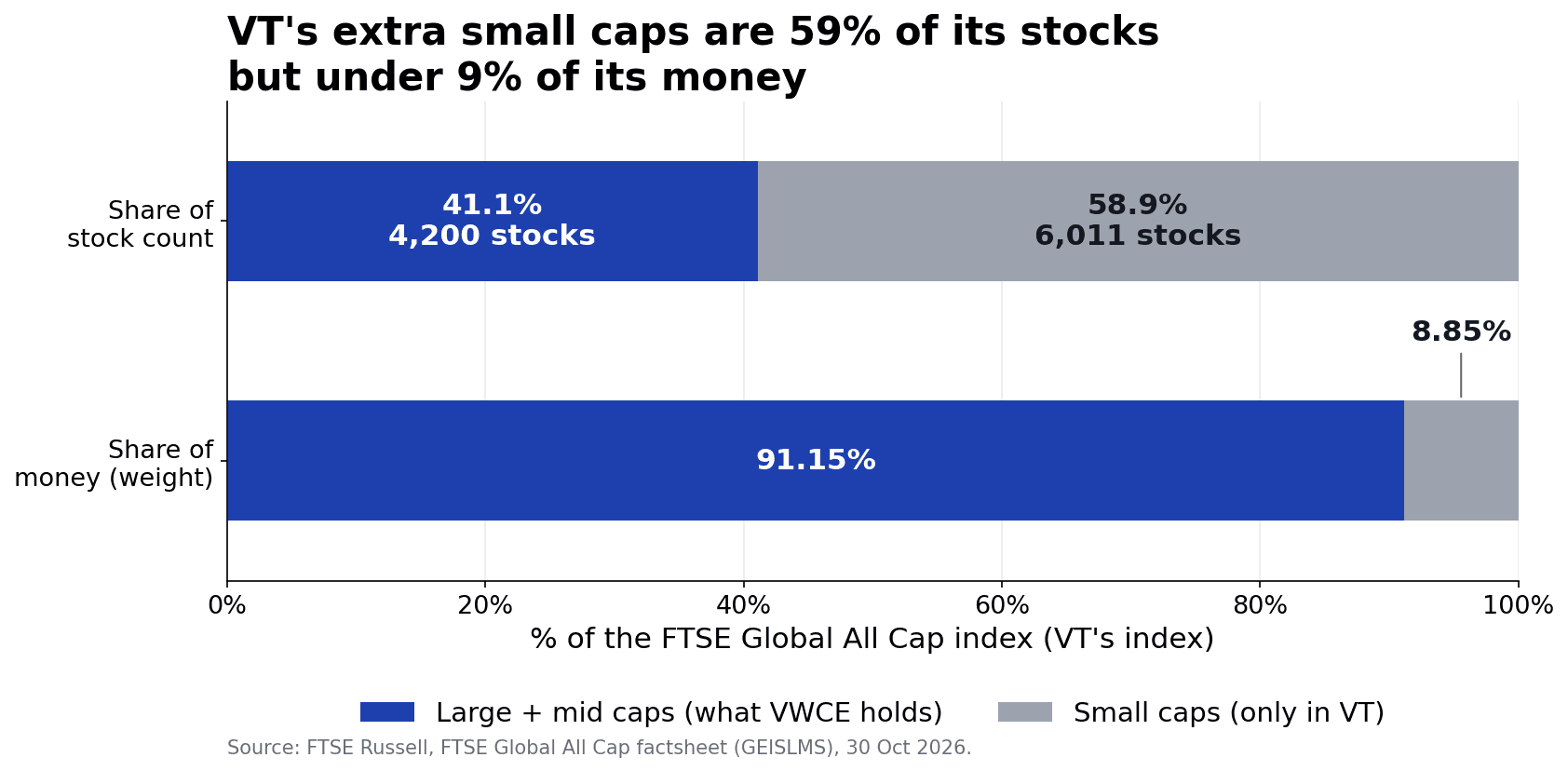 Data: FTSE Russell, FTSE Global All Cap factsheet, 30 Oct 2026 (10,211 stocks: 4,200 large + mid, 6,011 small; small caps $10.08tn of $113.92tn).
The extra 6,000 companies are 58.9% of the index's stock count and 8.85% of its weight. The other 91.15% of VT's index sits in the same large and mid caps VWCE holds. A real small-cap tilt takes a separate small-cap fund next to either world fund, and the overlap between the two is worth checking before you add it. The MSCI World vs MSCI ACWI comparison covers the other big index family.
VWCE vs VGLA / VALL: the European twin of VT's index
VGLA and VALL are one fund under two tickers: the Vanguard FTSE Global All Cap UCITS ETF. VGLA is the Xetra listing in EUR; VALL trades on Euronext Amsterdam and Borsa Italiana in EUR and in London in GBP. It tracks the same FTSE Global All Cap index as VT, from Ireland, and accumulates its dividends.
| VWCE | VGLA / VALL | |
|---|---|---|
| Index | FTSE All-World | FTSE Global All Cap |
| Yearly fee | 0.14% | 0.07% |
| Stocks held | 3,821 | 6,977 (a sample of 10,221) |
| Fund size | $87,295m | $2,573m |
| Launched | 23 July 2019 (this share class) | 18 August 2026 |
| Modelled cost for an EU holder | 0.293% | 0.226% |
Data from the VGLA factsheet and the VWCE factsheet, both at 30 September 2026.
On paper VGLA is the cheapest route to the whole world for a European: VT's index, half VWCE's fee, no PRIIPs block and no US estate-tax exposure. It is also about three months old and samples 6,977 of the index's 10,221 stocks. There is no year of tracking difference or trading-spread history to tell whether the 0.07% shows up in returns. VWCE has a seven-year record and 34 times the assets, for about €7 a year more per €10,000 in modelled cost. MFFT's VT UCITS equivalent page lists VGLA next to the other Irish world funds with their fees, and the best world ETFs roundup covers SPYI and others.
If you live in the US: why VT, not VWCE
VT is the US equivalent of VWCE, and for a US investor it costs 0.06% a year in the model above against about 0.293% for VWCE, a gap of roughly $23 a year per $10,000: $8 of extra fee plus about $15 of Irish withholding on VWCE's US dividends, which an American cannot credit. VWCE also counts as a passive foreign investment company for a US taxpayer, and the IRS asks a US shareholder of a PFIC to file Form 8621 in a range of cases, including distributions and sales.
If you are weighing VT against US-only funds instead, the VT vs VTI vs VOO comparison covers that choice.
Which one to buy
| You are | Fund | Why |
|---|---|---|
| EU resident, retail broker | VWCE | Buyable, accumulating, Irish domicile, 0.293% modelled yearly cost, seven-year record |
| EU resident, fine with a new fund | VGLA / VALL | VT's index from Ireland, 0.226% modelled cost, launched August 2026 |
| EU resident who already holds VT | Compare your local dividend tax with the table above | Selling may trigger tax; VT costs more each year at every local rate in the table |
| US resident | VT | 0.06%, about 10,000 stocks, no PFIC filing |
VWCE and VT hold nearly the same country mix, about 62% in the US, so the currency risk of a world ETF is nearly the same for both. If your pick will sit next to funds you already own, or a small-cap fund you plan to add, enter them together in the portfolio analysis tool to see how much they overlap and your combined country exposure.
Frequently asked questions
- Can I buy VT in Europe?
- Usually not as a retail investor. Under the EU's PRIIPs regulation a fund needs a key information document before it can be sold to retail investors, and US issuers like Vanguard did not produce one for VT, so EU brokers stopped retail purchases in 2018. Existing holders could keep or sell. Some brokers allow purchases for clients they classify as professional, which is a broker-by-broker exception.
- What is the US equivalent of VWCE?
- VT, the Vanguard Total World Stock ETF. Both are Vanguard whole-world funds with about 62% in US stocks. VT tracks the FTSE Global All Cap index with about 10,000 stocks for 0.06% a year, while VWCE tracks the FTSE All-World, the same universe without small caps, with 3,821 stocks for 0.14%. VT pays dividends quarterly; VWCE reinvests them.
- Is VWCE Irish domiciled?
- Yes. VWCE is a share class of Vanguard Funds plc, an Irish UCITS fund. Ireland's treaty with the US sets 15% withholding on the US dividends the fund receives, which costs about 0.15% a year inside the fund and cannot be reclaimed. Because it is Irish, VWCE stays outside the US estate-tax filing rule that applies to non-US holders of US assets above $60,000.
- What is the difference between VWCE and VGLA?
- VGLA (also listed as VALL) is the Vanguard FTSE Global All Cap UCITS ETF: VT's index in an Irish, accumulating wrapper, for 0.07% a year against VWCE's 0.14%. It samples 6,977 stocks against VWCE's 3,821, but it launched on 18 August 2026 with $2.6bn, against VWCE's $87bn and seven-year record, so it has no tracking history yet.
- Should a US investor buy VWCE?
- No. For a US investor VT does the same job for 0.06% a year, while VWCE costs about 0.29% once its fee and the 15% Irish withholding on US dividends are counted, roughly $23 more per $10,000 each year. VWCE is also a foreign fund that counts as a PFIC, and the IRS asks PFIC shareholders to file Form 8621 in several cases.
Free Financial Tools
Stay updated
Get notified when we publish new articles.
Related posts

MSCI World vs MSCI ACWI: What the Extra 11% Buys You
MSCI ACWI is MSCI World plus about 11% emerging markets. How much they overlap, what the return gap was worth, and when to pick each one.

Dividend vs Growth Stocks: Same Return, Different Tax Bill
Dividend vs growth stocks: at the same total return, the dividend payer can leave you ~13% poorer after 25 years of tax; a tax-free wrapper erases the gap.
VOO vs QQQ vs SCHD: VOO and QQQ Overlap 52%, Which to Own
VOO and QQQ overlap by about 52% of weight; VOO and SCHD share about 8%. Ten-year returns, the 2022 falls, and which of the three to own.