VWCE vs VWRA: Same Fund, Different Currency. Which to Buy?
 Dennis Vymer
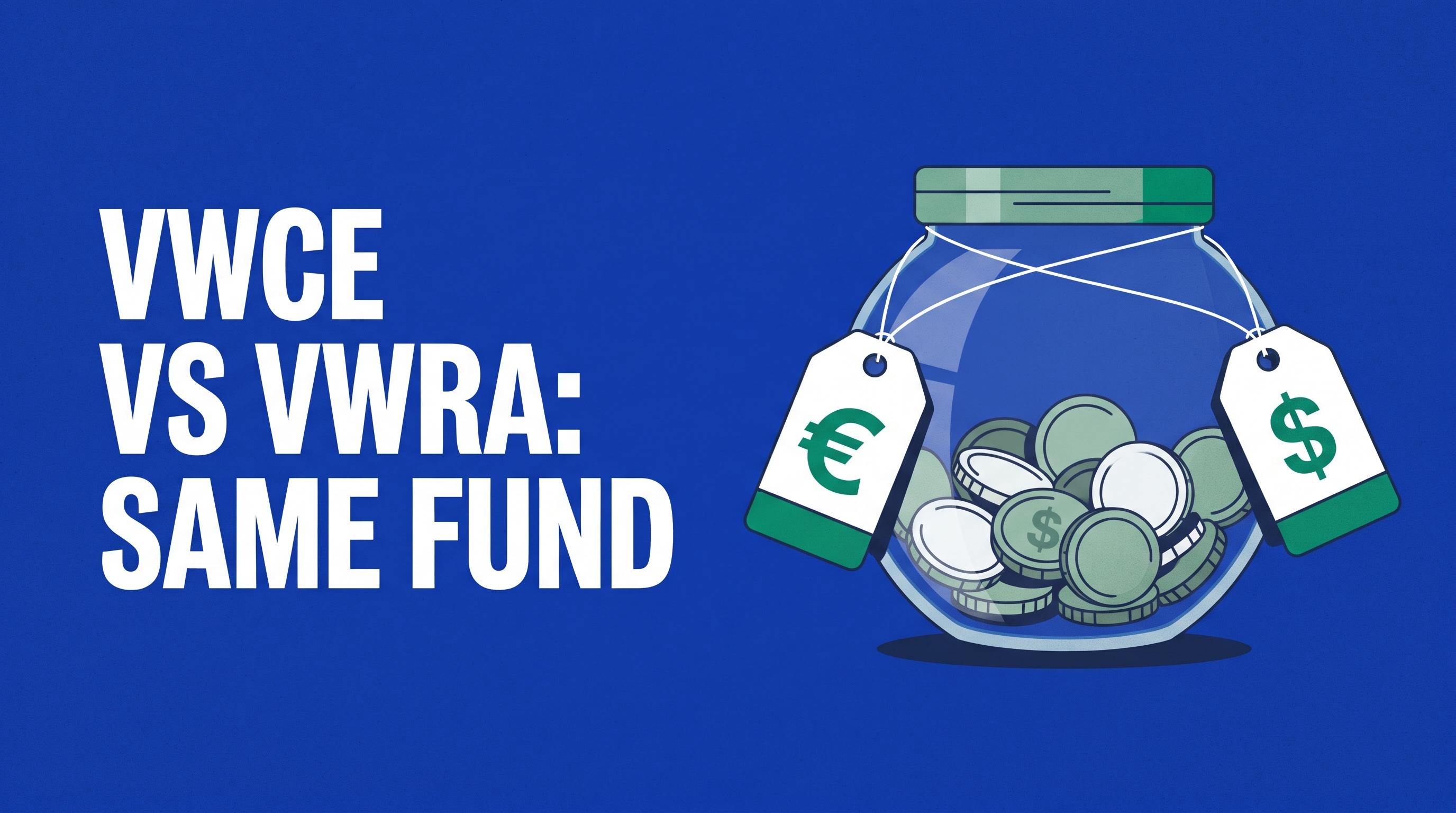
VWCE and VWRA are the same fund: one Irish share class (ISIN IE00BK5BQT80), same 0.14% TER, same holdings and the same currency exposure. VWCE is listed on Xetra in EUR, VWRA on the London Stock Exchange in USD. Buy the listing that matches the currency your broker account already holds: VWCE if you fund in euros, VWRA if you hold USD. The only lasting difference is the FX conversion fee you pay on every purchase and sale.
How big that fee gets depends on the broker more than on the ticker. A euro investor who puts €500 a month into VWRA instead of VWCE for 20 years gives up between €154 and €1,274 of the final pot, conversion back to euros included. The range comes from what each broker charges per conversion, from about 0.03% to 0.25%, or a flat $2 minimum. If you get paid in a third currency, like Czech crowns or Singapore dollars, both listings need one conversion anyway. The costly mistake there is accidentally paying for two.
If you hold an S&P 500 or MSCI World ETF next to the All-World fund, type every ticker you own into the free portfolio analysis tool (no sign-up). It unpacks each fund into the stocks inside and shows the share of holdings two funds have in common, weighted by position size. Its Sources column flags every stock held by two or more funds. Entered together, VWCE.DE and VWRA.L should come back with the same companies and the same country and sector split, because they are one fund.
VWCE vs VWRA at a glance
| VWCE | VWRA | |
|---|---|---|
| Fund | Vanguard FTSE All-World UCITS ETF (USD) Accumulating | Same fund, same share class |
| ISIN | IE00BK5BQT80 | IE00BK5BQT80 |
| Yearly fee (TER) | 0.14% | 0.14% |
| Index | FTSE All-World | FTSE All-World |
| Dividends | Reinvested (accumulating) | Reinvested (accumulating) |
| Fund base currency | USD | USD |
| Trading currency | EUR | USD |
| Main exchange | Xetra (also Euronext Amsterdam, Borsa Italiana) | London Stock Exchange |
| Regular trading hours | 09:00 to 17:30 CET | 08:00 to 16:30 UK time |
| Share class assets | $62.19bn, shared by every listing | $62.19bn, shared by every listing |
| Stocks held | 3,574 | 3,574 |
The fee, ISIN, listings and assets come from Vanguard's product page (as at 31 October 2026), and the stock count from the October 2026 factsheet. The trading hours are from Deutsche Börse and the London Stock Exchange. The same share class also trades in London in pounds as VWRP and on SIX Swiss Exchange in francs, where it keeps the VWRA ticker. Add the distributing class and the whole fund holds $88.84bn.
Is VWCE in EUR or USD?
The fund's base currency is the US dollar, because Vanguard calculates its net asset value in USD every day. The trading currency is whatever the exchange quotes in: VWCE shows a euro price on Xetra and VWRA a dollar price in London. Your real currency exposure is set by the 3,574 companies inside, whichever ticker you bought, and 62.8% of the fund sits in US companies according to the factsheet.
Each listing's price is the same basket converted at the day's exchange rate. Here are the closes from 20 November 2026, converted with that day's ECB reference rates (1 EUR = 1.0990 USD = 0.83735 GBP = 0.9223 CHF):
| Listing | Close on 20 Nov 2026 | In EUR at the ECB rate | Gap vs VWCE |
|---|---|---|---|
| VWCE (Xetra, EUR) | €159.39 | €159.39 | base |
| VWRP (London, GBP) | £133.52 | €159.46 | +0.04% |
| VWRA (SIX, CHF) | CHF 146.88 | €159.25 | -0.08% |
| VWRA (London, USD), implied | $175.17 | €159.39 | n/a |
The euro close is from Vanguard Netherlands, the pound close from Vanguard UK and the franc close from Vanguard Switzerland. A same-day London dollar close for VWRA could not be confirmed from a source, so the dollar line is implied rather than observed: €159.388 × 1.0990 = $175.17. The small gaps on the other two most likely come from bid/ask spreads and the different moments each exchange closes.
In formula form, VWCE's euro price ≈ VWRA's dollar price ÷ EURUSD. Say the dollar loses 5% against the euro while US stocks stand still in dollars. VWRA's dollar price barely moves for its US part, but every one of those dollars buys 5% fewer euros when you sell. VWCE's euro price drops on screen the same day instead, so a euro-based investor loses the same amount either way. Less dollar exposure takes a currency-hedged share class, which costs extra. Hedged vs unhedged world ETFs walks through whether that is worth paying for.
What actually differs: FX fees, spreads and trading hours
Here is what the mismatched listing costs a euro investor who puts €500 into the fund at the start of every month for 20 years at 7% a year. With no FX cost that is €120,000 paid in and €255,203 at the end. Interactive Brokers' AutoFX adds about 0.03% to the exchange rate on cash accounts. Trading 212 charges 0.15% on buys and sells in another currency; DEGIRO charges 0.25% for its automatic conversion. IBKR's manual spot conversion costs 0.002% but at least $2 per order, which on €500 a month comes to 0.366% at the ECB's 23 November rate of 1.0939.
| Euro investor's route | FX cost per buy | Fees paid over 20 years | End value lost | Converting back on sale | Total |
|---|---|---|---|---|---|
| VWCE, paid in EUR | 0% | €0 | €0 | €0 | €0 |
| VWRA, IBKR AutoFX | 0.03% | €36 | €77 | €77 | €154 |
| VWRA, Trading 212 | 0.15% | €180 | €383 | €382 | €765 |
| VWRA, DEGIRO AutoFX | 0.25% | €300 | €638 | €636 | €1,274 |
| VWRA, IBKR manual FX each month | 0.366% | €439 | €933 | €5 | €938 |
 Data: computed for €500/month over 20 years at 7%, ECB rates of 23 Nov 2026, end value lost plus conversion on sale; FX fees from the IBKR, Trading 212 and DEGIRO fee pages, Nov 2026.
The model leaves out commissions, spreads and taxes, and the 0.14% TER is identical for both listings, so it already sits inside the 7%. The totals run from 0.06% to 0.5% of the €255,203 pot. IBKR manual FX costs more per buy than DEGIRO (0.366% against 0.25%) yet less in total. The sale is one large conversion, so the $2 minimum adds only about €5, while the percentage-based routes charge their full rate again on the whole pot (€636 at DEGIRO). On a €500 order IBKR's $2 minimum costs twelve times what AutoFX does, and converting once a quarter instead of every month shrinks it. One IBKR catch: AutoFX only works for buy orders in cash accounts. A margin account borrows the trade currency instead, with interest running until you convert by hand.
Non-euro Europeans can end up paying for two conversions on Trading 212. It lets you pay for an order in the account's primary currency or in the asset's currency, and the primary currency is fixed at opening (multi-currency rules). A Czech investor with a euro primary account who deposits crowns, swaps them to euros and then orders VWRA paid in euros gets converted twice. CZK to EUR, then EUR to USD: 0.30% per purchase. On the same €500 a month that costs €765 of end value plus €763 when converting back, about €1,530, double the single-conversion route. Buy VWCE with those euros, or convert the crowns straight to dollars and pay for VWRA in USD. On IBKR, crowns go into a CZK balance and have to be sent as CZK, since a euro transfer to that account gets returned.
 Data: computed for €500/month (CZK 12,228 at the ECB rate of 23 Nov 2026) over 20 years at 7%, 0.15% per conversion, end value lost plus conversion on sale; Trading 212 FX fee and multi-currency pages, Nov 2026.
Both listings belong to a $62bn share class. For a monthly buyer, the bid/ask spread on either is usually small next to an FX fee. Quotes are tightest while the listing's home exchange is open: Xetra runs 09:00 to 17:30 CET, London 08:00 to 16:30 UK time, which is the same window seen from two time zones. Use a limit order priced in the listing's own currency and skip the first minutes after the open.
Which one to buy, by where you live
| Where you live or get paid | Buy | Why |
|---|---|---|
| Eurozone, paid in EUR | VWCE | No conversion in or out |
| UK, paid in GBP | VWRP | Same share class in pounds, no conversion |
| UK or anywhere, already holding USD | VWRA | Dollars go straight in |
| Singapore or another USD-funded account | VWRA | No SGD listing exists, and Trading 212 offers no SGD account |
| Czechia, Poland, Sweden, Hungary | Whichever listing your broker reaches in one conversion | No CZK, PLN, SEK or HUF listing exists |
| US person | Neither | US tax treats Irish funds as PFICs |
Crown, zloty, krona or forint savers pay the same for either listing. On Trading 212 with a CZK primary account both cost 0.15% per purchase, and with IBKR AutoFX both cost about 0.03%. The tiebreaker is bookkeeping: a euro position is easier to track if your tax return, your tracker or a later move into the eurozone runs in euros. A dollar position suits anyone whose cash flow is in dollars. On IBKR, search for VWCE and choose the Xetra listing in EUR; with euros already in the account, nothing gets converted.
US investors should skip both, and the VWCE vs VT comparison covers the US-domiciled fund that does the same job without the PFIC paperwork.
VWCE vs VWRP and VWRL
VWRP is the same share class yet again, priced in pounds in London. Its 20 November close of £133.52 converted to €159.46, within 0.04% of VWCE, per Vanguard UK.
VWRL belongs to a different share class of the same fund: ISIN IE00B3RBWM25, the same 0.14% fee, but it pays dividends out quarterly instead of reinvesting them. It holds $26.66bn of the fund's $88.84bn and trades as VWRL in London (GBP), Amsterdam (EUR) and on SIX (CHF), as VWRD in London in dollars, and as VGWL on Deutsche Börse. So VWCE vs VWRL is a question about dividends and how your country taxes them, which accumulating vs distributing ETFs answers. The tickers can mislead here: VWRL is a different share class from VWRA, while VWCE is the same one.
Should you switch from VWCE to VWRA?
Moving from one listing to the other means selling, paying a commission twice, crossing the spread twice and converting once. In most countries the sale also realises any gain for tax, all to end up with the same units of the same share class. Keep the old position where it is and point new money at the listing that matches your account currency from now on.
Holding both is fine: two tickers of one share class overlap completely by construction, so together they behave as one position.
VWRA vs an MSCI World ETF
FTSE All-World, the index behind VWRA, includes emerging markets, Taiwan's TSMC at 1.7% of the fund among them (factsheet). MSCI World covers developed markets only. The MSCI World vs MSCI ACWI comparison works through what leaving emerging markets out has meant, and the FTSE All-World index explainer shows what the index both listings track actually holds.
Before the next monthly order, look at which currency already sits in your broker account and which listings that broker offers, and set the order on the listing that needs no conversion. If other ETFs sit next to it, put the whole list into the portfolio analysis tool and check the overlap figure and the Sources column before adding a fund that mostly repeats the All-World one.
Frequently asked questions
- Are VWCE and VWRA the same ETF?
- Yes. Both are listings of one share class, Vanguard FTSE All-World UCITS ETF (USD) Accumulating, ISIN IE00BK5BQT80, with the same 0.14% fee, the same 3,574 stocks and the same currency exposure. VWCE trades in euros on Xetra, VWRA in dollars on the London Stock Exchange. The only lasting difference is the FX fee you pay if your account currency doesn't match the listing.
- Is VWCE in EUR or USD?
- VWCE trades in euros, while the fund's base currency is the US dollar, the currency Vanguard uses for its daily net asset value. Neither decides your currency risk: that comes from the companies inside, with about 63% of the fund in US companies. VWCE's euro price is simply VWRA's dollar price divided by the EUR/USD rate, so a euro investor gains or loses the same in both.
- What is the difference between VWCE and VWRP?
- Only the trading currency. VWRP is the same accumulating share class as VWCE (ISIN IE00BK5BQT80, 0.14% fee) quoted in pounds on the London Stock Exchange. On 20 November 2026 VWRP's close of £133.52 converted to €159.46, within 0.04% of VWCE's €159.39. A UK investor paid in pounds avoids an FX fee with VWRP; a euro investor avoids it with VWCE.
- Can I hold both VWCE and VWRA?
- Yes, and nothing breaks. They are two tickers of one share class, so together they behave exactly like a single position, with complete overlap. There is no reason to sell one to consolidate: a sale costs commissions, spreads, a conversion and possibly tax. Keep the old position and send new money to the listing that matches your account currency.
- How do I buy VWCE on IBKR?
- Search for VWCE and choose the Xetra listing, which trades in EUR. If your account already holds euros, no conversion happens. If it holds another currency, a cash account can use AutoFX, which adds about 0.03% to the rate on buy orders, or you convert manually at 0.002% with a $2 minimum per conversion. Margin accounts borrow euros instead of converting, so convert by hand.
Free Financial Tools
Stay updated
Get notified when we publish new articles.
Related posts
FTSE All-World Index: What You Actually Own
The FTSE All-World holds ~4,200 large and mid caps in 49 countries, but about 63% is US. See what you really own, and how much of it is the S&P 500.
VWCE vs VT: Which Vanguard World ETF Costs You Less?
US investors: VT, at 0.06% vs 0.14%. In the EU the all-in cost is near a tie (0.29% vs 0.31%), so access, dividend tax and estate rules favour VWCE.
MSCI World vs MSCI ACWI: What the Extra 11% Buys You
MSCI ACWI is MSCI World plus about 11% emerging markets. How much they overlap, what the return gap was worth, and when to pick each one.