Pay Off Your House Early or Invest? The Break-Even Math
 Dennis Vymer
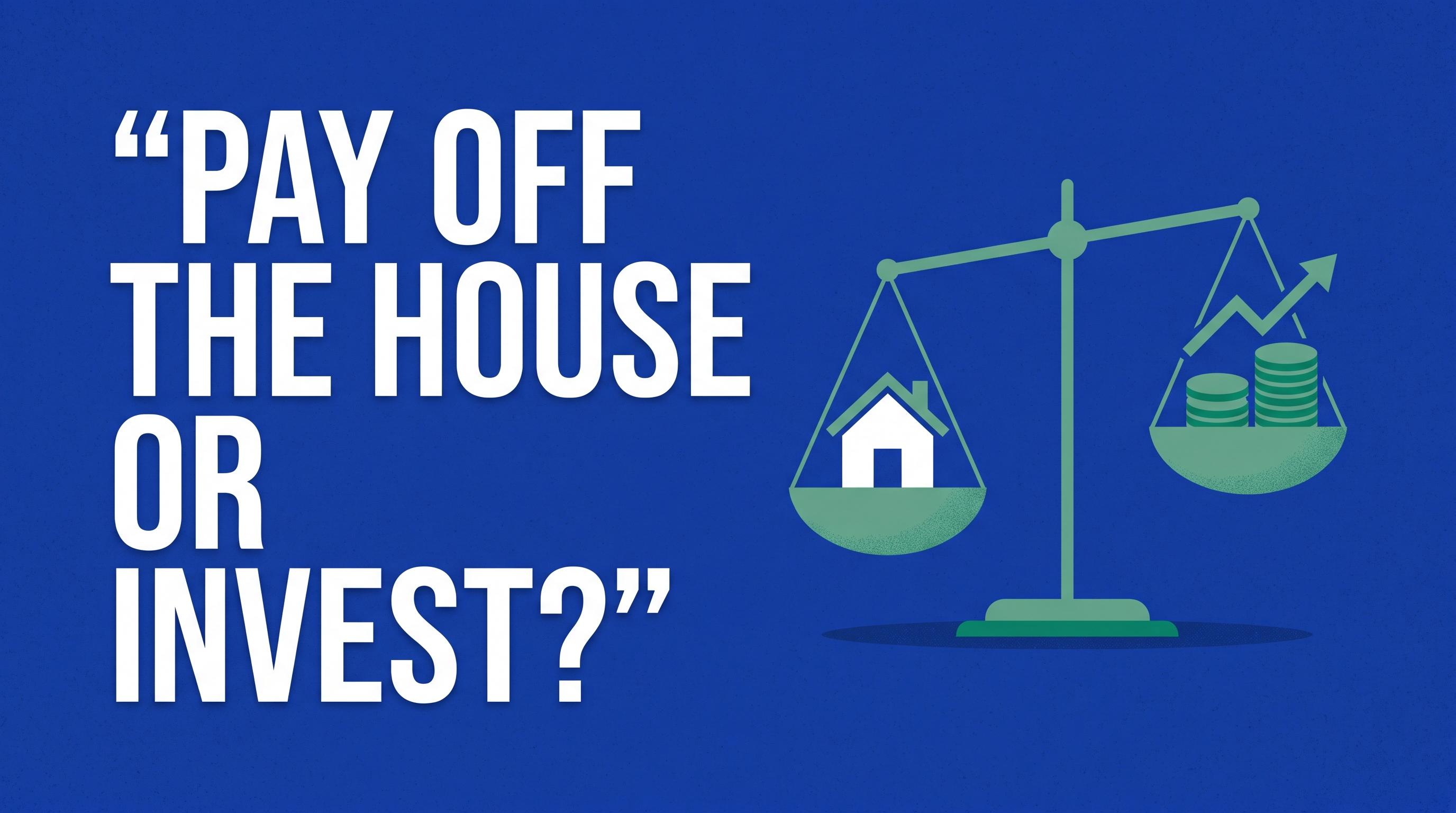
Investing the spare money beats paying off your house early when your after-tax return beats your mortgage's effective rate: about 5.1% for a 5% loan, 5.6% if 15% of gains go to tax. On S&P 500 returns since 1928, investing an extra $500 a month beat prepaying a 5% loan in all 74 rolling 25-year periods, and a 7% loan in 61.
The odds move toward prepaying when your rate is 6% or higher with about 15 years left, when you retire within a few years, or when you would sell your funds after a 30% drop. Build a cash buffer before either route. An extra mortgage payment earns its fixed rate the day you make it, while the S&P 500's long-run return only reached investors who kept buying through years like 1974 and 2008. To test your own balance, rate and horizon, the free mortgage vs investment calculator puts prepaying, investing and a split side by side, no sign-up.
The break-even return is your mortgage rate after tax
Every extra payment earns exactly your mortgage rate with no risk, because it erases interest you would otherwise pay, so an investment has to beat that rate after tax to come out ahead.
Two details push the bar slightly above the rate on your loan papers. Mortgages charge interest monthly, so a 5% loan costs 5.12% a year once that compounding is counted. And investment gains get taxed, while interest you never pay is not taxed at all. Here is the break-even annual return for the worked example below ($300,000 balance, 25 years left, $500 a month extra):
| Mortgage rate | Break-even return, no tax | Break-even return, 15% tax on gains |
|---|---|---|
| 3% | 3.0% | 3.4% |
| 5% | 5.1% | 5.6% |
| 7% | 7.2% | 7.8% |
The 15% column uses the long-term capital gains rate that, according to the IRS, most US investors pay; swap in your own country's rate. The tax is charged once, on the gains, at the end of year 25.
What an extra $500 a month does either way
The example: $300,000 left on the mortgage, 25 years to go, $500 a month of spare cash, and a 5% rate.
Prepay first. The scheduled payment is $1,754. With $500 on top, the loan is gone after 16.2 years, and from then on the whole $2,254 a month goes into an index fund until year 25. Total interest falls from $226,131 to $138,418, a saving of $87,713.
Invest the extra. You pay the $1,754 for the full 25 years and put $500 into the fund every month from the start.
Both households own the house outright at year 25, so the only difference is the size of the portfolio. At steady returns, before tax:
| Mortgage rate | 5% return | 7% return | 9% return |
|---|---|---|---|
| 3% | Investing ahead by $50,400 | Investing ahead by $127,300 | Investing ahead by $240,800 |
| 5% | Prepaying ahead by $3,400 | Investing ahead by $67,700 | Investing ahead by $174,600 |
| 7% | Prepaying ahead by $71,900 | Prepaying ahead by $9,200 | Investing ahead by $88,400 |
At a 5% rate and a 5% return the two routes land $3,400 apart, because 5% sits just below the 5.1% break-even. The gaps on the investing side grow faster because the $500 compounds in the market for all 25 years, while the prepayer's money only reaches the market after year 16. The compound interest guide shows why those first years carry so much weight.
98 years of S&P 500 returns: how often investing won
Markets don't deliver a steady 7%, so the same example was run through every 25-year stretch of actual S&P 500 total returns, dividends included, using Aswath Damodaran's annual return data at NYU Stern for 1928 to 2025. That gives 74 overlapping runs, the first starting in 1928 and the last in 2001.
| Mortgage rate | Runs where investing won | Worst run for investing | Median run |
|---|---|---|---|
| 3% | 74 of 74 | Investing ahead by $112,900 (1957 start) | Investing ahead by $424,200 |
| 4% | 74 of 74 | Investing ahead by $81,500 (1958 start) | Investing ahead by $376,800 |
| 5% | 74 of 74 | Investing ahead by $39,700 (1958 start) | Investing ahead by $329,400 |
| 6% | 73 of 74 | Prepaying ahead by $7,100 (1958 start) | Investing ahead by $272,500 |
| 7% | 61 of 74 | Prepaying ahead by $59,700 (1959 start) | Investing ahead by $206,500 |
 Data: S&P 500 total returns 1928–2025, Damodaran, NYU Stern. Inputs: $300,000 balance, 25 years left, $500 a month extra, monthly contributions, pre-tax, no fund fees.
The 13 runs where a 7% mortgage won started in 1955 to 1961 and in 1991 to 1996. Both groups hit their worst markets well into the run, the 1973 and 1974 losses of 14% and 26% for the first group, and 2000 to 2002 plus the 37% fall of 2008 for the second. By then the investor's portfolio had years of contributions riding on those drops, while the prepayer had little or nothing in the market yet and then put $2,620 a month in at the lower prices. If you want to see how often long holding periods lost money at all, do stocks always go up covers that with the same kind of data.
This is one market's history, US large-company stocks, and the 74 runs share most of their years, so they are not 74 independent tests. It also holds the mortgage rate fixed for 25 years and ignores fund fees and tax. With 15% tax on gains, the bar rises by about half a percentage point, as the first table shows.
Where mortgage rates sit in November 2026
Freddie Mac's weekly survey put the average US 30-year fixed rate at 7.11% for the week of November 12, 2026, the zone where the history above starts to split. In the euro area, the ECB's composite cost of borrowing for new house-purchase loans was 3.54% in July 2026, a level at which investing won all 74 runs.
When paying off the house early is the better call
- Your rate is 6% or more and you have about 15 years left. Shorter runs leave less time to recover from a crash. With 15 years to go on the same $300,000 loan, investing won 69 of 84 historical runs at 6% and 65 of 84 at 7%, and the worst 7% run, starting in 1997, left the investor $48,900 behind.
- You would sell in a crash. The 74-run test assumes the investor kept buying through 1974 and 2008. Selling near the bottom turns many winning runs into losses, which is the gap measured in the investor return gap.
- You retire within a few years. A paid-off house lowers the monthly spending your portfolio has to cover, which reduces sequence of returns risk in the first years of withdrawals.
Before either route, hold three to six months of expenses in cash first, because money paid into the house can only come back out through a new loan or a sale; this emergency fund guide helps you size it. Then read your loan contract, since some lenders charge a fee on early repayment or cap how much you can prepay each year.
The price of a paid-off house
In the 5% example, the median historical run left the investor $329,400 ahead after 25 years. At 3%, the median gap was $424,200. That is the price the prepayer pays for owning the house outright 8.8 years sooner at 5%, or 8.4 years sooner at 3%.
The calculator also models a middle route of one extra payment a year, with the rest invested. In its default example ($300,000 at 6.5%, 30 years left, $500 a month spare), it clears the loan in 24.3 years and ends with $719,562 after inflation, against $790,983 for investing every spare dollar and $627,448 for paying off first.
How to decide with your own numbers
Put your balance, rate, years left and monthly spare cash into the mortgage vs investment calculator, set a return you would still believe after a bad decade, and switch on tax at your own rate. If investing only wins at returns above 7%, prepay or split. If it wins at 5%, invest, and keep the emergency fund in cash next to it.
Frequently asked questions
- Is it better to pay off your mortgage early or invest?
- Investing comes out ahead when your after-tax return beats your mortgage's effective rate, about 5.1% for a 5% loan before tax. On S&P 500 returns since 1928, investing an extra $500 a month beat prepaying a 5% mortgage in all 74 rolling 25-year periods. At 7% it won 61 of 74. Prepaying is the safer choice with a rate of 6% or more and about 15 years left, or a habit of selling in crashes.
- Is paying off a mortgage a guaranteed return?
- Yes, every extra payment earns exactly your mortgage rate, because it removes interest you would otherwise pay, and that return does not depend on markets. It is also untaxed. The catch is liquidity: money in the house only comes back out through a new loan or a sale, so keep three to six months of expenses in cash before you prepay.
- Should I pay off my mortgage before retirement?
- Often it helps, because a paid-off house lowers the monthly spending your portfolio has to cover, which reduces sequence of returns risk in the first years of withdrawals. Weigh that against the return you give up: with 15 years left on a 7% loan, investing still won 65 of 84 historical S&P 500 runs, so prepaying buys lower risk rather than a higher expected result.
- Should I pay off a 3% mortgage early?
- Rarely, on the numbers: the break-even return for a 3% loan is about 3.0% before tax and 3.4% with 15% tax on gains. In every 25-year period of S&P 500 returns since 1928, investing an extra $500 a month beat prepaying a 3% mortgage, by at least $112,900 on a $300,000 loan. Prepay only if a paid-off house matters more to you than that gap.
- What if the market crashes right after I invest instead of prepaying?
- A crash early in a 25-year run usually costs less than one in the middle. The runs where prepaying a 7% mortgage won started in 1955 to 1961 and 1991 to 1996, when the worst years landed well into the run. If you keep buying through the drop, the long-run odds still favour investing; selling near the bottom turns many of those winning runs into losses.
Free Financial Tools
Stay updated
Get notified when we publish new articles.
Related posts
50/30/20 Rule Examples: 5 Budgets and When It Breaks
50/30/20 rule examples: on 3,000 take-home it is 1,500 needs, 900 wants, 600 savings. Five budgets, gross vs net, and why 20% takes ~37 years to retire.
Lifestyle Creep Examples and What They Cost Your FI Date
Seven everyday lifestyle creep examples, priced in years. Spend a whole raise and you can reach financial independence later than if you never got it.

Income Concentration Risk: Your Job Is Your Biggest Position
Your salary is the biggest undiversified position you own: one employer, one country, one currency. What actually reduces income concentration risk.